

How Did Life Begin?
Originally Published in Return to God Magazine
Volume 1, Number 1, p4.
AUTHOR'S NOTE
 Evolution
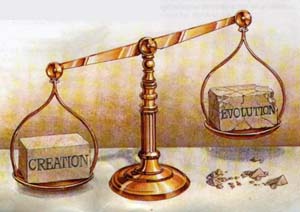
vs. creationism is a point of controversy today, particularly in terms of
what schools should teach children. Some people advocate evolution as a more
scientific theory and argue that teaching creationism violates the
separation of church and state. Others feel that creationism has as much or
more supporting scientific evidence. Even Christians are divided on the
topic. Some believe that the process of evolution was God's creation
mechanism. They believe the six days of creation described in Genesis are a
poetic, not a scientifically accurate description. Others take the Bible
literally -- believing that God created everything exactly as described in
Genesis and that no process of evolution occurred.
Evolution
vs. creationism is a point of controversy today, particularly in terms of
what schools should teach children. Some people advocate evolution as a more
scientific theory and argue that teaching creationism violates the
separation of church and state. Others feel that creationism has as much or
more supporting scientific evidence. Even Christians are divided on the
topic. Some believe that the process of evolution was God's creation
mechanism. They believe the six days of creation described in Genesis are a
poetic, not a scientifically accurate description. Others take the Bible
literally -- believing that God created everything exactly as described in
Genesis and that no process of evolution occurred.
God and His creative powers are far beyond our capabilities to comprehend. During this life we will never be able to fully comprehend how His creation came into existence. However, we shouldn't blindly accept theories without examining the evidence. God told us not to believe everything, but to test the spirits (1 John 4:1). We should always have reasons for what we believe.
When I began to research this article, I had the viewpoint of one who was taught evolution theory in school but who also believed in God. I felt that evolution was a scientific explanation for our being here and could well have been the way that God chose to create. After reading some good creation science books (see references), I was astounded. It seems many of the points regarding evolution that I had come to believe as facts were just theories -- they had little or no supporting scientific evidence. The table below shows some of the problems with the theory of evolution.
|
EVOLUTION THEORY |
SCIENTIFIC EVIDENCE |
| Life came from non-living matter. (spontaneous generation) | Never observed or duplicated in a laboratory |
| Random processes create life. The universe has existed for 30 billion years, during which time all life evolved by random processes. | Creating a simple 100 component non-living organism would take 3 billion billion billion billion billion billion billion years. The simplest protein that can be termed "living" has 400 components. |
| Sexual reproduction came about by evolution. | Two humans had to evolve at the same time and place, having complementary reproductive systems. If one system wasn't complete or compatible, the species would become extinct. |
| Species evolve from other species. | There are no fossils of transitional life forms. Organisms have never been found to cross the boundaries between species. |
| Mutations are the primary way that new genetic material for evolution. | Greater than 99% of mutations are is available defects. No mutant has been observed that has become a different species. |
Properties of the earth and the relationship of living things to it are a testament to a Designer. The atmosphere, the climate, the soil, water, mineral deposits are all essential to life. The human body is also a testament to a Designer. The more I study, the more difficult it is to understand how one can ever believe all the intricacies of the body or the universe were created by a random series of events.
Did God then use evolution as a creation mechanism? No one can know, however three factors seem to suggest that this is not the case. First, there is no physical evidence (e.g., fossil record) that life evolved; second, the order of creation described in Genesis is opposite of the order proposed by the theory of evolution and third, in Genesis 1:24, God created animals "each according to its kind."
So why should all of this be troubling? After all, what really matters is that we believe in God and have relationship with Him through Jesus. It is troubling because many people who were taught the theory of evolution as truth never study or question the accuracy of the theory and come to believe in "natural processes" -- that God did not create life. Indeed, some question whether there is a God at all. If natural processes created everything, there is no need for God. Natural processes become a substitute for God. A living, personal God becomes just a religious concept for people who "need that sort of thing".
In reality, all scientific evidence points directly to a Designer (God) as the Creator. Experience has shown that people close the door on this issue, which has such eternal consequences, without thoroughly researching available evidence. We should always keep an open mind and continue to test all information that is presented to us. I hope this information and its references provide useful information to help others explore the issue of creation vs. evolution.
"The Earth was born about 5 billion years ago... Scientists are not certain of just how it happened, but they believe that life began about 2 billion years ago in the shallow waters of some unknown seacoast. A group of atoms came together in a very certain way. They formed a new type of molecule -- a giant molecule, much bigger than all the other atom groups nearby. This large molecule could do something that no other molecule could do. It was able to take simple atoms and smaller molecules from the sea and make a new giant molecule just like itself." --Benjamin Bova "The Giants Of The Animal World"
Is this really the way it happened? This evolutionist's view leaves many questions unanswered. How did life emerge from non-living matter? Exactly how was that first living molecule formed? How did that molecule evolve to the complex life forms we have today?
CAN LIFE EMERGE FROM NON-LIVING MATTER?
No one has ever observed the creation of life from non-living matter, or spontaneous generation. Even given ideal laboratory conditions, scientists haven't been able to create life from non-living matter. Life has been found only to come from life. This has been seen so consistently that it's called the Law of Biogenesis.
Even if scientists could demonstrate spontaneous generation, it's unlikely that life on earth began this way. Two basic components of life, proteins and DNA, have characteristics that make their spontaneous generation unlikely. Proteins couldn't have evolved if the early earth had oxygen in its atmosphere, because the parts that make up proteins, amino acids, can't join in the presence of oxygen. There had to be oxygen in the atmosphere, however. Without oxygen, there could be no ozone in the upper atmosphere and without the ozone layer, the sun's ultraviolet radiation would quickly destroy life. How then, can evolution explain both ozone and life?
Scientists have also found that the long chains of amino acids necessary for life cannot be formed in water. This fact seriously impacts the theory that life began in "the waters of some unknown seacoast."
The creation of DNA, the basic building block of life presents an interesting evolutionary problem. DNA cells contain thousands of genes that direct the functioning of living beings, including inherited characteristics, growth, organ and system structure. The DNA for each species is unique. Certain protein molecules or enzymes must be present for DNA to replicate, however those enzymes can only be produced at the direction of DNA -- the DNA itself has the blueprint for the specific enzymes it needs to replicate. Each depends on the other and both must be present for replication to take place. How evolution could explain this has never been answered.
HOW WAS THE FIRST LIVING MOLECULE FORMED?
Evolutionists think that the early earth contained a primordial "soup", consisting of all the components necessary for life. Through random processes, the components combined in exactly the right way to form the first living organism. Mathematical probabilities show that for all practical purposes, it is impossible for complex living systems that consist of many inter-relating parts to come about through random processes. Let's look at the mathematical chances for life to come about in this way.
PROBABILITIES SHOW RANDOM PROCESSES CANNOT CREATE LIFE
The most basic type of protein molecule that can be called "living" has 400 linked amino acids, each composed of 4-5 chemical elements. Each chemical element consists of a unique combination of protons, electrons and neutrons. To simplify our calculations, let's look at the probability of chance formation of an even simpler system, one that would contain only 100 elements.
We'll assume that all the necessary components were readily available in the "soup" and that the components had to come together in the right order to form a functioning system. Let's call our 100 element system "Fred". All the elements that make up "Fred" would have to combine in the correct order to get a functioning "Fred". It's likely that most of the possible combinations of the components would have to be tried before "Fred" was formed. The section below describes the procedure for calculating probabilities. The probability of chance formation of "Fred" would be 1 in 100 factorial (or 1 x 2 x 3 x 4...x 99 x 100) or 1 in approximately 10158 (1 followed by 158 zeros). To get an idea of how large this number is, there are only 1080 (1 followed by 80 zeros) electrons in the universe.
CALCULATING PROBABILITIES
As an example, let's assume only two components are required to form a living system, say X and Y. If they came together in the form XY, the system would function. If they came together as YX, it would not work. The probability of a functioning system randomly forming with these two components would be 1 in 2.
For a system requiring three components to function: there are six possible ways that three components could combine: XYZ, XZY, YXZ, YZX, ZXY, ZYX. Only one of the six combinations would work. We can express the probability or chance that the correct combination of three components would occur as 1 in 6.
For larger numbers of components, it is easier to calculate the number of possible combinations of the components by multiplying the numbers from 1 to the number of components together. This is called the factorial.
To find the number of possible combinations for our two component system, we compute 2 factorial, or 1x2=2 possible combinations. For three components, the calculation is 3 factorial or 1x2x3=6; for four components: 4 factorial or 1x2x3x4=24.
The number of possible combinations gets very large very quickly as the number of components increase. For example, the number of possible combinations of ten elements is 10 factorial, or 1x2x3x4x5x6x7x8x9x10 = 3,628,800. The probability of chance formation of a ten element system is 1 in 3,628,800. For chance formation of an eleven element system, the probability is 1 in 39,916,800.
INSUFFICIENT TIME FOR CREATION OF EVEN SIMPLEST ORGANISMS
Evolutionists claim that the evolutionary process occurred over billions of years, so they feel there was plenty of time to make all the necessary trial combinations and eventually get the correct ones. Let's test this theory for "Fred".
Astronomers estimate the universe to be less than 30 billion years old, which is 1018 seconds. Let's assume that it takes a billionth of a second for components to combine to form a trial 100 component "Fred". Let's also assume that the number of electrons in the universe, 1080, is representative of the number of basic components available for trial combinations of "Fred". This would allow 1078 trial combinations of 100 component "Fred" to occur at a time. With these assumptions, from the origin of the universe until today, 10105 trial combinations could be made (1018 x 109 x 1078). Unfortunately, to be sure to get a functioning "Fred" we would need 10158 combinations. The chance of one of our 10105 combinations being the correct, functioning "Fred" is approximately one chance in one hundred million billion billion billion billion billion (1 in 1053). It would take over three billion billion billion billion billion billion billion years to try all the possible combinations to be sure to create Fred. Written out, that's over 3, 000, 000, 000, 000, 000, 000, 000, 000, 000, 000, 000, 000, 000, 000, 000, 000, 000, 000, 000, 000, 000 years. There hasn't been nearly enough time to create even simple "Fred" in the universe's supposed 30,000,000,000 years of existence!
CHANCE OF CREATION OF COMPLEX LIFE FORMS BEYOND ASTRONOMICAL
The example, "Fred" is greatly simplified. In fact, "Fred" couldn't be considered a living organism. Remember, the most basic type of protein molecule that can be called "living" has 400 linked amino acids, each composed of 4-5 chemical elements. To build this simplest life form would require at least: 400 amino acids x 4 chemical elements for a total of at least 1600 components. The combinations necessary to randomly form this new 1600 component "Fred" are staggering: 1600 factorial (1 x 2 x 3...x 1599 x 1600).
The probability of chance formation of the DNA for a simple self- replicating organism has been calculated at 1 in 10167,636 (a 1 followed by 167,636 zeros). Imagine the probability of chance formation of the brain (with 10,000,000,000 very complex, specifically designed and interrelating cells)! The brain is only one of the many complex and interrelating systems in the human body! How long would it take by random processes to form a human?
RECENT DISCOVERIES SHOW LIFE EMERGED IN SHORTER TIME PERIOD
Recent discoveries show the earth's population changed from simple worm- like organisms to diverse life forms, including all the major animal groups, in a period of just zero to ten million years. This is significantly less than the 30 billion years evolutionists previously believed that the evolutionary process took -- or the over three billion billion billion billion billion billion billion years required to create our 100 component "Fred" by random processes.
All thirty of the complex animal phyla alive today and thirty phyla that are now extinct appeared during the five to ten million year-long period, called the Cambrian era. Because of dating uncertainties, scientists cannot ascertain whether all the life forms appeared all at once or gradually over the five to ten million year period. This new information, discovered by a team of geologists from the Massachusetts Institute of Technology, Harvard University and Russian researchers from the Geoscience Institute in Yakutsk, will certainly create problems in justifying the evolution theory that random processes over long time periods created life on earth.
WHAT ABOUT SEXUAL REPRODUCTION?
Assuming a human could somehow "evolve", how would it reproduce? Reproduction in mammals requires a male and a female. Two humans had to evolve at the same time and place, having complex and totally different, but complementary reproductive systems -- male and female. The physical components of both systems had to be compatible. If one of the systems had a slight defect or wasn't complete, reproduction would be impossible and the species would become extinct. The chemical and emotional systems of the male and female also had to be compatible for reproduction to take place. These same constraints apply to sexual reproduction in plants, animals and other mammals. Sexual reproduction was essential for life on planet earth. An incredible sequence of chance evolutionary events must have occurred to account for it!
There simply hasn't been enough time for the "natural" random process of evolution to create the living beings of this world. In terms of mathematical probability, evolution isn't a rational explanation for the existence of our world's complex living systems!
IS THE EARTH OLD ENOUGH?
It is important to evolution theory that the earth be old enough to provide adequate time for "natural random processes" to work. There are more than 100 techniques for measuring the age of the earth. Only a few methods date the earth as billions of years old. Most methods date the earth as thousands to millions of years old. While there is no way we can definitely tell how old the earth is, it is interesting to see the disagreement between the various dating methods and to understand that currently accepted dating methods are not as accurate as many would like to believe.
SCIENTIFIC DATING METHODS NOT RELIABLE
The "old" (billions of years old) estimates of the earth's age are obtained by radiometric systems that measure age by the rate of disintegration of radioactive elements in the earth's rock layers. Objects, such as bones, are dated by testing the volcanic rocks under which they're buried. It's assumed that the volcanic eruptions that buried the objects occurred after the objects were deposited, so finding the age of the volcanic rock will give an approximate age of the object. The most commonly used radiometric tests include Potassium Argon, Uranium Lead and Carbon 14. Radiometric tests have been found to be inaccurate in many instances. For example, some volcanic rocks from an 1801 eruption in Hawaii were tested by Potassium Argon and found to be 160 million to 3 billion years old! Potassium Argon tests have been found to be inaccurate when heat was involved with the object being tested. Therefore, heat from a volcanic eruption could greatly alter the results of this test. How can scientists be confident about dating volcanic rock with Potassium Argon? Yet many famous discoveries were dated by using this test on volcanic rock. Potassium Argon was used to date Skull 1470, said to be 2.8 million years old and "Lucy", dated at 3 million years.
LIVE MOLLUSKS 2300 YEARS OLD?
Live Mollusks dated at 2,300 years old, mortar from 800 year old English castle dated at 7,370 years old and fresh seal skins dated at 1,300 years old -- these are some of the inaccuracies of Carbon 14 dating. For accurate dating, Carbon 14 depends on a steady rate of radiation in the atmosphere. This steady rate of radiation can be disturbed by volcanic activity, industrial burning, solar flares, sunspots, cosmic radiation or meteors falling to earth, thus making the dating method inaccurate. Dating by Carbon 14 also doesn't support evolutionist's theories of the chronological progression of life throughout history. With Carbon 14 dating, coal is 1,680 years old (evolutionists place it at 100,000,000 years old), natural gas is 34,000 years old (thought to be 50,000,000 years old) and the saber-toothed tiger is 28,000 years old (thought to be 100,000 to 1,000,000 years old). To quote Curt Teichert of the Geological Society of America, "No coherent picture of the history of the earth could be built on the basis of radioactive datings".
THE EARTH COULD BE YOUNGER THAN PREVIOUSLY THOUGHT
Based on physical indications, the earth could be much younger than evolutionists think. Measurable amounts of helium gas are continually gathering in our outer atmosphere. The decay of the earth's uranium is one of the sources of helium. This helium cannot escape into outer space. If the earth was billions of years old, there would be as much as a million times more helium than is there now. Given the amount of helium in our outer atmosphere, the earth is estimated to be 10,000 to 15,000 years old.
TOPSOIL AND EROSION CONSISTENT WITH YOUNGER EARTH
The earth's topsoil has an average depth of seven or eight inches. Top soil is produced at an estimated rate of six inches in 5,000 to 20,000 years. If the earth is billions of years old there should be a lot more topsoil -- 300,000 inches or more! Because of erosion, the amount of sediment in the ocean is gradually increasing. If the ocean had existed for a billion years, there should be at least thirty times more sediment in it than there is.
LIVING THINGS AND POPULATION SPEAK OF YOUNGER EARTH
The oldest living things on earth, the bristle cone pine trees in Nevada and California, are 5,000 years old. California redwoods are 4,000 years old. If trees can live that long, why couldn't they live several thousands of years longer? Why are there no trees older than 5,000 years? If the population of the earth increased 1/2% per year for a million years (2.5 children per family), the present population of the earth would be 102100 (1 with 2,100 zeros after it). Earth's present population could have developed in 4,000 years given the 1/2% per year growth rate.
LIFE IMPOSSIBLE ON OLDER EARTH?
Every hour the sun shrinks about five feet or about 1/10 % per century. At this rate, just 100,000 years ago it would have been double its present size. Twenty million years ago it would have been touching the earth. Assuming this rate of shrinkage, life on the earth would have been impossible just one million years ago, due to heat and radiation from a large sun.
Since it was first measured in 1835, the earth's magnetic field has been steadily decaying. Based on this rate of decay, the magnetic field would have been the same as that of a magnetic star 10,000 years ago. Life would not have been possible in such an environment, thus life on earth more than 10,000 years ago would not have been possible.
MOON'S PHYSICAL PROPERTIES INDICATE A YOUNGER EARTH
The moon and earth steadily gather cosmic dust. During Apollo missions, NASA scientists expected to find a 54 foot layer of dust on the moon because of its 4.5 to 5 billion year estimated age. They actually found 1/8 inch to 3 inches of dust, which would take less than 8,000 years to accumulate. Scientists know that without the stabilizing influence of the moon, the earth would wobble. This would create wild swings in temperature, which would make life impossible. The moon is essential for life on earth. The amount of dust on the moon, suggests that the moon and consequently life on earth came into being 8,000 years ago or less. The distance of the moon from earth is gradually increasing by two inches a year. If this rate was constant, the moon and the earth would have been touching two billion years ago. If the moon had started out a reasonable distance from earth five billion years ago, it would now be out of sight.
DO SPECIES EVOLVE FROM OTHER SPECIES?
If life was created by evolution, one would expect gradual transitions among living things. The fossil record doesn't show gradual transitions. Species appear completely developed, not partially developed. Organs appear fully developed -- indeed, if they weren't the organism would probably die. There are many single cell life forms, but no known forms of animal life with 2, 3, 4 or even 20 cells. One would expect to find many of these, as transitional life forms. Experts feel that the fossil record is complete and has been thoroughly studied, yet there are evolution gaps between: - single celled life forms and invertebrates - fish and amphibians - amphibians and reptiles - reptiles and birds - primates and other mammals - many plants
In evolution theory, mutation is the primary way that new genetic material is thought to become available for evolution. However, more than 99% of induced mutations are defects. No mutant has ever been observed that crossed the line to another species. Organisms have never been found to cross the boundaries between species. This is because the size, number, and kind of chromosomes are different for each species. If two species have the same number of chromosomes, differences in size or shape prevent cross breeding. Abnormal crosses have always resulted in sterility of the offspring -- such as the breeding of a horse and donkey resulting in a sterile mule, or a lion and tiger resulting in a sterile liger.
VARIATION WITHIN SPECIES IS NOT EVOLUTION
Variation within a species is common, as we see in the many breeds of dogs, cats, cows, etc. A frequent example of "evolution" used in text books is the variation of the peppered moth. Prior to the industrial revolution in England, dark peppered moths were rare, the light colored ones were common. During the industrial revolution, factory soot covered tree trunks where moths landed. The light colored moths were now more visible to predators, thus their population decreased greatly, while the dark moths were now less visible to predators and multiplied. Textbooks say the light colored moth evolved into the dark colored moth during this time. Is this evolution? No new species resulted, just a variation within the species because of natural selection, or survival of the fittest.
EVOLUTION CAN'T EXPLAIN SYMBIOTIC RELATIONSHIPS
There are many instances where very different forms of life are completely dependent upon each other. An example is the relationship of the Pronuba moth and the yucca plant. The Pronuba moth lives in a cocoon in the sand at the base of the yucca plant. Pronuba moths hatch only on certain nights of the year, which are also the only nights that yucca flowers bloom. When the Pronuba moth hatches, it enters an open yucca flower and gathers pollen. It then flies to a different yucca plant, backs into the flower and lays its eggs with the yucca's seed cells. It pushes the pollen it had gathered into a hole in the yucca flower's pistil, so the pollen will fertilize the yucca's seed cells where the moth laid its eggs. The moth then dies. As the moth's eggs incubate, the yucca seeds ripen. When the eggs hatch, the moth larvae eat about one fifth of the yucca seeds. They then cut through the seed pod and spin a thread that they slide down to the desert floor. They burrow into the sand and spin a cocoon and the cycle continues. There are several kinds of yucca plants, each pollinated by its own kind of moth that is the right size to enter the particular flower. The yucca plant and the Pronuba moth are dependent on each other for reproduction, thus survival.
Other examples of symbiotic relationships between different life forms include fig trees and the fig gall wasp, parasites and their hosts and pollen-bearing plants and the honeybee. If one member of the symbiotic team evolved first, it could not have survived. Since both symbiotic members in each of these examples have survived, it is reasonable to conclude that they must have come into existence at the same time. Evolution has no explanation for symbiotic relationships.
EVOLUTIONISTS ADMIT PROBLEMS, STICK TO THEORY
Some evolutionists have admitted that their theories have scientific difficulties. Let's look at some of the thoughts of Charles Darwin who popularized the Theory of Evolution with his 1859 book, The Origin of Species. Darwin's greatest concern about his theory was that the existing fossil record didn't support it. In his book, Darwin stated "As by this theory innumerable transitional forms must have existed, why do we not find them embedded in countless numbers in the crust of the earth? The number of extinct species must have been inconceivably great!" He later stated "not one change of species into another is on record... we cannot prove that a single species has been changed". He felt that future discoveries would substantiate his theory and stated that "he who rejects these views on the nature of the geological record, will rightly reject my whole theory". To date, the geological record has not substantiated the Theory of Evolution.
DARWIN: EYE FORMED BY NATURAL SELECTION "ABSURD IN THE HIGHEST POSSIBLE DEGREE"
Darwin also admitted drawbacks of the evolution theory in trying to explain complex organs, such as the eye. "To suppose that the eye, with all its inimitable contrivances for adjusting the focus to different distances, for admitting different amounts of light...could have been formed by natural selection seems, I freely confess, absurd in the highest possible degree...The belief that an organ as perfect as the eye could have formed by natural selection is more than enough to stagger anyone."
Some evolutionists recognize the incredible scientific obstacles of evolution theory (as Darwin states: "...absurd in the highest possible degree..."), yet still choose to believe in evolution rather than in creation. To quote George Wald, Nobel Prize winner in physiology and medicine: "The reasonable view was to believe in spontaneous generation; the only alternative, to believe in a single, primary act of supernatural creation. There is no third position... One has only to contemplate the magnitude of this task to concede that the spontaneous generation of a living organism is impossible. Yet here we are -- as a result, I believe, of spontaneous generation."
COULD EVOLUTION HAVE BEEN GOD'S CREATION MECHANISM?
There are great difficulties in explaining evolution by natural processes, but what about Divine intervention? Did God choose to create by evolution? If He did, the way He used evolution is not consistent with evolutionist's theories. The account in Genesis, while not intended to be a scientific explanation, gives us more insight. In Genesis, God never spoke of creating transitional life forms. He created animals "each according to its kind". This is in agreement with our fossil record and with what we know about genetics, but doesn't agree with evolution theory. Genesis gives the order in which things were created. As shown in the table, this order of creation strongly disagrees with evolution theory.
|
CREATION ORDER |
EVOLUTION ORDER |
| Earth created before sun, stars (Gen. 1:1, 1:14) | Sun, stars existed before earth |
| Oceans created before land (Gen. 1:2) | Land existed before water |
| Light created before land (Gen. 1:3, 1:14) | The sun was the earth's first light |
| Plants were first created life (Gen. 1:11-12) | Marine organisms were first life |
| Land plants created before sun (Gen. 1:11-12,14-18) | Sun existed before land plants |
| Birds created before insects (Gen. 1:20,1:24) | Insects existed before birds |
| Man created before woman (Gen. 1:26, 2:15,2:22) | Woman existed before man (genetics) |
| Creation is completed (Gen. 2:2) | Creation process continues |
WE ARE HERE BY DESIGN, NOT COINCIDENCE
We have found no evidence to support the major ideas of evolution. There is no evidence that life can emerge from non-living matter. The mathematical odds of a human arising from random processes are beyond astronomical. The fossil record doesn't support transitions between species, nor has anyone ever observed such a transition. Evolution can't account for symbiotic relationships between different organisms.
There are so many incredible "coincidences" in our world. The earth's atmosphere has the right mixture of gases to support life. The sun is the right distance away and the right size to keep our climate comfortable. The tilt of the earth is right to give us moderate seasons. The proximity of the moon stabilizes the earth without causing excessive tides. There are many mineral deposits and natural resources to support our life. Topsoil supports the growth of food. The list is endless. These "coincidences" speak of a Designer.
The human body is a testament to a Designer. Our most sophisticated computers are no match for the human brain. The kidneys contain approximately 280 miles of tubes and filter 185 quarts of water a day from the blood. The heart pumps 5,000 gallons of blood a day. It beats approximately 100,800 times a day or 2,500,000,000 times in an average life time. The human skeletal structure is light and flexible, yet can withstand enormous stress. The eye has automatic aim, focus and aperture adjustment. It provides us with color three dimensional images. It can function in darkness to bright light and makes about 100,000 motions in a day. All of these complex systems function together. Can evolution really account for all of this? An honest assessment of available information must conclude there is powerful evidence to support the theory that the universe and all that is in it is a designed creation.
References and good books for further study include:
-
The Collapse of Evolution" by Scott M. Huse
-
Scientific Creationism by Henry M. Morris
-
A Scientific Approach to Christianity by Robert W. Faid
-
Unlocking the Mysteries of Creation by Dennis R. Petersen
-
In the Beginning by Walter T. Brown Jr.
For a booklet of this information, which includes illustrations that cannot be presented here, send $2.00 plus postage to Return to God, P.O. Box 159, Carnation, WA 98014-0159
Copyright 1994 by Return to God