

The Genetic Limits of Evolution
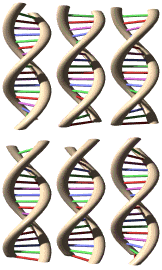 Evolution occurs through a history of genetic recombination
and natural selection. Genetic recombination creates the variability
found within a population, and selection inbreeds the chosen
characteristics creating a "pure-breed". Following a history of
selection the organism has limited genetic variability, and its
offspring are virtually identical. That is what you pay for when you buy
a registered animal or plant seed-line. You are buying a guarantee that
the traits, which have been selected, will not segregate out in
subsequent generations. The animal registration is verification that its
genotype is free from related variability, and the offspring from its
lineage will possess a known phenotype for the characteristics in
question.
Evolution occurs through a history of genetic recombination
and natural selection. Genetic recombination creates the variability
found within a population, and selection inbreeds the chosen
characteristics creating a "pure-breed". Following a history of
selection the organism has limited genetic variability, and its
offspring are virtually identical. That is what you pay for when you buy
a registered animal or plant seed-line. You are buying a guarantee that
the traits, which have been selected, will not segregate out in
subsequent generations. The animal registration is verification that its
genotype is free from related variability, and the offspring from its
lineage will possess a known phenotype for the characteristics in
question.
A pure-breed is a genetic homozygote, or an individual which no longer possesses alternative variations for the genes in question. Most genes are present as a number of varieties (alleles) and as a result the traits they produce are polymorphic or present in more than one form. The homozygote will no longer produce variable offspring because the genome can no longer pass a variety of genes to its daughter cells. Selection for any specific characteristic is "outselection" of the alternative alleles from the population. Natural selection, in this respect, works in the exact same way as artificial breeding. Selection removes genes from the population, and eventually eliminates the organisms ability to produce progeny that differ. Following a period of selection, the organisms ability to produce a variability is frequently lost forever.
Prior to selection, an organism will typically be heterozygote or have different copies of the gene at the same loci. A genetic homozygote can be generated for any characteristic. Simply mate two organisms possessing the desired trait, and one of their children will likely be pure-bred for a related gene. The test for homozygosity is rather simple. Basically; if every child possess a trait, the parent is a homozygote and from that organism a pure blood-line begins. Alternatively look for a family whose entire progeny possess a trait, and at least one of their parents is homozygote.
If both parents are heterozygote, or each has only one copy of the allele in question, then it is expected for 25% of their offspring to be homozygote.
(AA, Aa, aA, aa). 25% - aa
|
Parental Genotypes Heterozygotes (Aa) + (Aa) |
A | a |
| A | AA | Aa |
| a | aA | aa |
If you subsequently select the homozygote and mate it with another heterozygote; 75% of the offspring will be homozygote. This is how selection rapidly transforms a poplulation.
(Aa, aa, aa, aa). 75% - aa
Parental Genotypes
Heterozygotes /Homozygote
(Aa) + (aa)a a A Aa aa a aa aa
Animals evolve because nature selects from a pool of alleles, and the resulting homozygotes are genetically pure bred for the features which gave the organisms the specific adaptation. Although few characteristics are simplified to a single pair of alleles, it is clear that selection (inbreeding selected features) will generate and then multiply genetic homozygotes for the related genes within the population. If selection persists, these homozygotes will rapidly become predominant, and the group as a whole will become more limited genetically as a result of the selection. The reduction of alleles or heterozygosity from inbreeding has been shown to contribute to the decline, and eventual extinction of isolated population. (1)
 The
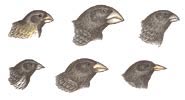
galapagos finch varieties are the result of genetic recombination just
like all the domestic breeds, and now just exist as several naturally
pure-bred species. Evolution occur because nature chooses (inbreeds)
particulars characteristics from existing variability, and following a
period of selective breeding the entire population becomes homozygous.
They are more fit for the specific conditions they were selected to, but
less able to change as a result.
The
galapagos finch varieties are the result of genetic recombination just
like all the domestic breeds, and now just exist as several naturally
pure-bred species. Evolution occur because nature chooses (inbreeds)
particulars characteristics from existing variability, and following a
period of selective breeding the entire population becomes homozygous.
They are more fit for the specific conditions they were selected to, but
less able to change as a result.
Although it would appear that evolution through meiotic recombination or classic mendelian genetics is largely a one-way street, we must remember that the wolf was a homozygote in nature. The wolf is part of a larger group, which also includes the hyena, jackal, fox, coyote, and others. The wolf was selected, along with these other natural canines, until it was a pure bred or genetic homozygote and would only produce wolf pups. The variety of breeds that was later isolated from the wolf lineage appears to have accumulated gradually because we eliminated the natural selection which previously kept the genome pure of this variability.
Contrary to popular opinions among creationists, this indicates an ability to produce continued variability following homozygosity. We were able to isolate the domestic breeds from the wolf, but apparently not because of alleles that were already present. The wolf was a pure breed, and it is likely that continued diversity among such purebred organisms is generated through cellular mechanisms known as homologous recombination. It is now certain that some genes are variable, and others are not. Genes that are involved with direct inter-species contact, such as toxins, are found highly variable among closely related species. In contrast, housekeeping genes are found conserved among vastly different organisms.
The tremendous diversity found isolated by domestic breeding may therefore be the result of variable genes or new alleles that have been generated by cellular mechanisms. As these changes are also responsible for environmental adaptation, the very basis of evolution is clearly the result of cellular intent instead of mutations. Given our knowledge of genetic recombination, the cell's ability to edit the genome is theoretically limitless.
References
- Inbreeding and extinction in a butterfly metapopulation Nature 392, 491-494 1998
- Inbreeding and linebreeding
- Segregation of Identical Homozygotes - Slide
Quotes
(1) Dessauer, H. C., G. F. Gee, and J. S. Rogers. 1992. Allozyme evidence for crane systematics and polymorphisms within populations of sandhill, sarus, Siberian and whooping cranes. Molecular Phylogenetics and Evolution 1:279-288.
There are 15 living species of cranes, all of which were sampled for this study. Based on protein electrophoresis, the two species of African crowned cranes are distinct from the remaining species, which are themselves divided into two groups. The "sandhill group" consists of seven species, and is distributed across the Old World, with the sandhill crane reaching North America. The "whooper group" consists of six species which are all restricted to the northern continents. Single species diversity was also analyzed. A significant result was the discovery that genetic diversity among whooping cranes was surprisingly high, similar to that for the six other species with which it was compared. This is contrary to expectations of genetic loss due to a population bottleneck of some 15 individuals in the 1940s. The possibility should be explored that some mechanism exists for rapidly restoring genetic variability after population bottlenecks.
