



Noah's Ark Expeditions and Sightings
 Noah's
Ark expeditions have fascinated
archaeologists and explorers for hundreds of years,
drawing many adventurers to the mountains of Ararat, the
landing place of the ark as recorded in the book of
Genesis. Yet after numerous expeditions, the true
location of the ark remains a mystery. Many claim to
have seen the ark, and some even say they have found and
entered it, but none of the alleged witnesses have been
able to produce unequivocal proof of the ark's existence
or find their way back a second time. The stories often
contradict each other as well, but they almost all agree
that they saw Noah's ark on Mt. Ararat, located in
eastern
Turkey near the border with
Armenia and
Iran.
Noah's
Ark expeditions have fascinated
archaeologists and explorers for hundreds of years,
drawing many adventurers to the mountains of Ararat, the
landing place of the ark as recorded in the book of
Genesis. Yet after numerous expeditions, the true
location of the ark remains a mystery. Many claim to
have seen the ark, and some even say they have found and
entered it, but none of the alleged witnesses have been
able to produce unequivocal proof of the ark's existence
or find their way back a second time. The stories often
contradict each other as well, but they almost all agree
that they saw Noah's ark on Mt. Ararat, located in
eastern
Turkey near the border with
Armenia and
Iran.
Most searches for the ark have been
conducted on
Mt. Ararat. However, it should be noted that the
Bible states that the ark landed "on the mountains of
Ararat", denoting an entire mountain range rather
than an individual
mountain. The place known as the mountains of
Ararat, thought to be the same as the ancient kingdom of
Urutu, encompasses a broad area. Mt. Ararat is only one
peak in this mountain range, but it is commonly believed
to be the final resting place of the ark. Some claim
that Mt. Ararat, the tallest mountain in the area, is
the only one with a large enough ice cap to preserve the
ark for thousands of years, while others point out that
the volcanic mountain experiences frequent mudflows that
would have destroyed the ark long ago. Additionally,
some researchers are convinced that it is impossible for
the ark to have landed on Mt. Ararat because the
mountain was not in existence at the time of the flood
but was actually formed much later as a result of
volcanic activity.
"The water receded steadily from the earth. At the end of the hundred and fifty days the water had gone down, and on the seventeenth day of the seventh month the ark came to rest on the mountains of Ararat. The waters continued to recede until the tenth month, and on the first day of the tenth month the tops of the mountains became visible." Genesis 8:3-5 (NIV)
Significance of the Discovery

Noah's ark, if discovered, would have a profound significance to the Christian community as a whole. For some, the discovery would serve to reaffirm their faith in the Bible by validating the account of the Great Flood in Genesis. It would prove once again that the Bible is accurate and can be accepted as true. It would also convince many people that the worldwide flood, now relegated to the realm of myth, actually occurred. This in turn would challenge currently held ideas of uniformitarianism and the evolutionary view of the fossil record. If a boat as large as the ark were to be discovered on the summit of Mt. Ararat, it would point to a global flood large enough to float the boat to the top of the mountain.
Other people groups would also be affected by such a discovery. Christianity is not the only religion to believe in Noah's flood; for example, the Islamic Qur'an also makes mention of Noah's ark and the Great Flood. Additionally, the country of Turkey as a whole would benefit from greatly increased tourism if Noah's ark was ever positively identified.
Some people believe that Noah's ark would be the greatest archaeological find of all time, and claim that it would completely destroy any basis for a belief in evolution. They hope that it would force the world to finally accept the truth of scripture. Even the (now deceased) editor of National Geographic, Dr. Melville Bell Grosvenor, said that, "If the ark of Noah is discovered, it will be the greatest archaeological find in human history, the greatest event since the resurrection of Christ, and it would alter all the currents of scientific thought."[1]. However, while the discovery of the ark would definitely be seen as strong evidence for the global flood by Christians experiencing doubt, it is unlikely that such a discovery would alter the opinions of most secular scientists who firmly hold to their beliefs in evolution. The Bible says that:
"First of all, you must understand that in the last days scoffers will come, scoffing and following their own evil desires. They will say, "Where is this 'coming' he promised? Ever since our fathers died, everything goes on as it has since the beginning of creation." But they deliberately forget that long ago by God's word the heavens existed and the earth was formed out of water and by water. By these waters also the world of that time was deluged and destroyed." 2Peter 3:3-6 (NIV)While the discovery of Noah's ark may strengthen the Christian arguments for creation and a young earth, there will always be those who will deny the truth of the Bible. They would likely refuse to accept a discovered Noah's ark as genuine and, even if they did accept it, might protest that the ark could have been brought up to the mountain by other means and did not necessarily arrive atop the mountain by floating there during a worldwide flood.
Dangers of the Search
Mt. Ararat, located on Turkey's border with Armenia and Iran and near Iraq, is often at the center of political tension and regional turmoil. Kurdish terrorist groups live on the mountain, hiding out in caves and attacking groups that try to search for the ark[2]. Many explorers report being shot at and harassed by the terrorists. The PKK (Kurdistan Workers Party) especially has been responsible for attacks on explorers. Since 1928 the group has been working to fight the Turkish government by attacking the tourist trade, and those who enter Mt. Ararat, where the PKK often hides out, come under attack[3].
During the Cold War, Turkey shut off all access to the mountain because of its proximity to the Soviet Union. Searchers were suspected of spying under the guise of looking for the ark. When the Cold War ended, the Turkish government began letting people enter and explore the area, but many locations are still restricted and expeditions often have to be postponed, cut short, or canceled altogether due to a lack of support from the government[3].
In addition to political conflict, searchers also face natural dangers. Mt. Ararat, a volcanic mountain, last erupted in 1840, and today earthquakes, mudslides, rock slides, and avalanches threaten those who attempt to ascend the mountain. Explorers often look for the ark in crevasses and canyons such as the Ahora Gorge, but these locations are dangerous and several adventurers have lost their footing and fallen to their deaths in the deep cracks of the mountain. Weather can also prove treacherous, with storms, lightning, and thick fog, and explorers must watch out for wild animals such as wolves that roam the area[3].
Expeditions and Claims
Many individuals and groups have been drawn to Ararat and the surrounding area in search of Noah's ark. The prospect of such a discovery has captivated audiences around the world for years. Some even claim to have seen and entered the ark, but, unfortunately, these claims remain largely unsubstantiated. Many of the claims seem far-fetched at best, causing people to doubt that the tales contain any truth at all. Indeed, since multiple groups claim to have discovered the ark at different sites, they cannot all be right, yet they continue to display their findings as being unequivocal evidence of the ark. Robert Cornuke describes the persistent insistence of searchers that theirs is the true Noah's ark as a result of "ark fever". He says that, "At its most severe, ark fever can cause otherwise sane people to see what they want to see--or expect to see--rather than what's really there."[1].As of yet, no one has been able to produce conclusive proof that the ark has been discovered.
Dr. Friedrich Parrot (1829)

Friedrich Parrot traveled to Turkey in 1829 for the purpose of climbing Mr. Ararat. His party stopped first at the monastery at Echmiadzin, where they were joined by a deacon from the monastery, and next at St. James' monastery at the foot of the mountain. Parrot and his group made three attempts to climb the mountain, finally reaching the summit on the third ascent, which occurred on September 27, 1829. They erected two crosses in the ice, which they brought up the mountain from the monastery. Parrot saw no sign of Noah's ark, but traveled to the summit in order to disprove the belief of the Armenians in the area that it was impossible to reach the summit because God was protecting the ark there. This belief arose from the story of a monk named Jacob who attempted to reach the summit of Ararat. According to legend, Jacob would spend the day climbing but at night God would move him back to his starting point, so that he awoke no further than he had been at the beginning of the previous day. Finally, God sent an angel to the monk to tell him that no one would be allowed to reach the summit of Mt. Ararat. The angel also supposedly gave the monk a piece of the ark, which he brought back to the monastery at Echmiadzin as a relic[4]. The St. James monastery was also said to have contained relics made from wood taken from Noah's ark. Sadly, the monastery was destroyed by the eruption of Mt. Ararat in 1840[5].
Prince John Joseph Nouri (1887)
Prince Nouri, the archdeacon of Babylon, visited Mt. Ararat in 1887 after hearing that it was the landing place of Noah's ark. On his third climbing attempt, he reached the summit of Mt. Ararat on April 25, 1887. There he found Noah's ark buried by rocks and ice. He returned home and, some years later, tried to raise enough support to bring the ark to the Chicago World's Fair in 1893. Unfortunately, before he could do so he was attacked, allegedly by the founders of a satanic church. The assault distraught him to the point of insanity and he died soon after of pneumonia in a mental hospital without ever disclosing the location of the ark[5].
Lieutenant Roskovitsky (1916)
As the story goes, Vladimir Roskovitsky, a pilot in the Russian Air Force, spotted the ark from the air. Upon hearing Roskovitsky's report, the Russian czar ordered a group of his soldiers to form a ground expedition to visit Noah's ark. The Russian troops reportedly made a thorough investigation of the ark and took detailed measurements and photographs. However, on their way back to the czar the Russian Revolution broke out and all of the documents were lost, never to be recovered[6]. This story first appeared in New Eden, a magazine, in 1940 and quickly spread. When asked for further details about the story, the editor directed everyone to his source, Benjamin Franklin Allen, who revealed that the story as it appeared in the magazine was almost all fiction except for the fact that some Russian pilots had reported possibly sighting the ark during World War I[7].
Ed Davis (1943)
In 1943, Sgt. Ed Davis became friends with his transport driver, a Kurdish man named Badi Abas, while stationed in Hamadan in northern Iran. One day, the man's grandfather visited Badi Abas and Davis at the military base and offered to take them to see Noah's ark, which had been exposed due to high temperatures that melted the ice concealing it. Davis later described the journey to the ark, saying that after three days they reached Noah's ark, which had been broken into several pieces by an earthquake and was lying on its side[8]. Davis also reported seeing artifacts, including oil lamps, ancient tools, and even dried beans and jars still full of honey, all of which had fallen out of the ark and been collected and put in a cave in order to protect them from being defiled by outsiders[9]. Heavy snowfall forced Davis and the Abas family to leave the mountain the next day without further exploring the ark[10].
People regard the Davis account with suspicion for several reasons. First of all, Davis states that he could see Mt. Ararat from where he was stationed in Hamadan, located 400 miles away from Mt. Ararat. He then claimed that he and the Abas family traversed the entire distance to the mountain in half a day. Both of these claims are nearly impossible. Davis corrected his story several times after being told that his facts did not line up. When subjected to a lie detector test, he faltered at the question: "Are you lying when you state that no one ever told you about the Ark other than Abbas and the Bible?" He initially responded in the negative but acknowledged that he had discussed the topic with other people. Some speculate that, while Davis probably was taken to a mountain and shown what he believed to be Noah's ark, it may have actually been another mountain, such as Kuh e Alvand. Many natives to the area believe that the ark came to rest on Kuh e Alvand, located only 60 miles from Hamadan, rather than on Mt. Ararat[11]. While the truth of Ed Davis story remains in question, his firsthand account of seeing the ark has served as an inspiration to many other ark researchers, including Ray Anderson and Robert Cornuke.
In 1955, Fernand Navarra climbed up to the Parrot Glacier (named for Friedrich Parrot) on Mt. Ararat with his son Raphael[12]. They found several pieces of petrified wood in a crevice and removed a 5-foot-long wooden beam which they brought back with them. The wood was subjected to Carbon-14 dating by five different laboratories, with results placing the age of the wood between 260 and 790 A.D. Various other less reliable methods of dating showed the wood to be around 5000 years old. Furthermore, Navarra's truthfulness was called into question when other members of his expedition claimed that Navarra purchased old wood and planted it on the site[13].
The SEARCH (Scientific Exploration and Archaeological Research Foundation) group formed in the 1960s and began searching for the ark based on Navarra's story. They looked in the ice where Navarra dug up his petrified timber but found nothing. Navarra, after disappearing for a day, led the SEARCH group to a new location. Subsequently, they dug up five samples of petrified wood which were carbon-dated at 600 to 1700 years old. Such convenient coincidences concerning Navarra reinforced the opinion that he had planted the samples on the mountain[7].
Eryl Cummings (1970s)
In the 1930s, Eryl Cummings began gathering information from various people who claimed to have seen or been to Noah's ark. Using their descriptions, he began searching for Noah's ark on Mt. Ararat. He made several expeditions to the mountain in the 1970s and in 1972 his wife, Violet Cummings, published the book Has Anybody Really Seen Noah's Ark? on the subject[14]. During his expedition in 1972, Eryl Cummings took aerial photography of Mt. Ararat, which other ark searchers later examined thoroughly. After going over the photos, some of Cummings' associates claimed to see what they thought were several pieces of the ark, but the alleged pieces were never positively identified[15].
Ray Anderson (1970s)
Ray Anderson joined several expeditions to Ararat in the 1970s. He worked closely with other well-known ark researchers, including Eryl Cummings, Lawrence Hewitt, James Irwin, and Ed Davis. Ray Anderson also spent time closely examining the hundreds of pictures taken on his expeditions, hoping to find some sign of the ark. He also looked at slides from video footage of the mountain taken by Chuck Aaron on a helicopter flight around Mt. Ararat's glaciers. Anderson noticed three areas that looked like possible pieces of the ark. He showed them to Ed Davis, who said that he recognized the "fishhook-shaped" formation as the area where he had seen a piece of the ark. Anderson was never able to visit the sites in his pictures because the Turkish government refused to grant permission to search the mountain[16]. Nevertheless, he continued to hope that the ark would one day be discovered. Others cite his pictures as evidence that the ark exists on Mt. Ararat. The three pictures, however, while interesting, are far from conclusive and may turn out to be natural formations rather than pieces of the ark. They can be viewed on Ray Anderson's website, Noah's Ark- Fact Not Fiction.
Dr. John Morris and ICR (1972)
John Morris has made thirteen visits to Mt. Ararat in search of Noah's ark. He went on his first expedition in 1972 along with John Bultema, Roger Losier, John Seiter, and Bill Ellison[17]. When invited to join the Cummings-Irwin group in 1982, Morris formed a separate expedition group sponsored by the Institute for Creation Research (ICR) that would work in conjuction with the Cummings-Irwin group. After allowing the Cummings-Irwin group to explore the mountain, however, Turkish officials were reluctant to let another group in. Therefore, the ICR expedition was delayed and was unable to join the Cummings-Irwin group[18].
On his many expeditions, Dr. Morris and his associates took thousands of pictures of Mt. Ararat, both from on foot and from the air. Helicopters were often used to take pictures, when weather and the Turkish government permitted it. Several times, the searchers noticed mysterious "boat-like" objects that might have been the ark, but after further inspection, the objects turned out to be natural formations. Expeditions have dug down into the glacier on Ararat in search of the ark and have used scientific equipment to search for objects hidden in the ice, but no signs of the ark were uncovered. Morris continues to hope that the ark may be preserved somewhere on Ararat or in the vicinity, and a large portion of the mountain remains to be searched[19].
Updates by John Morris on the Search for Noah's Ark:
- Noah's Ark the Search Goes On by John D. Morris, Ph.D., Acts & Facts, Feb 1, 1983.
- The Search for Noah's Ark: 1983 by John D. Morris, Ph.D., Acts & Facts, Nov 1, 1983
- A Report on the ICR Ararat Expedition, 1987 by John D. Morris, Ph.D., Acts & Facts, Jan 1, 1988.
- The Search for Noah's Ark: Status 1992 by John D. Morris, Ph.D., Acts & Facts, Sep 1, 1992.
- Progress In The Ark Search by John D. Morris, Ph.D., Acts & Facts, Feb 1, 2002.
Ron Wyatt and the Durupinar Site (1977)
- Main Article: Durupinar site
 Ron
Wyatt, a former nurse
anesthesiologist, maintains that the ark rests not
on top of
Mt. Ararat but in nearby Dogubayazit in eastern
Turkey. The site, known as the Durupinar site, was first
photographed by a Turkish Air Force pilot in 1959, and
the strange formation was further investigated by the
Archaeological Research Foundation (ARF) in 1960, at
which time they determined that the
Durupinar site was merely an interesting geological
phenomenon arising from purely natural causes and was
not, after all, the remains of Noah's ark. No further
interest in the Durupinar site was shown until Ron Wyatt
began searching it for remains of Noah's ark. He first
visited Turkey in 1977 and again in 1979. In 1984 he
returned, along with James Irwin, John Morris, and
Marvin Steffins. David Fasold and John Baumgardner also
accompanied Ron Wyatt on some of his expeditions.
Although the men who investigated the Durupinar site
with Wyatt originally thought that it held some promise
of being the landing site of Noah's ark, all but Wyatt
and Fasold changed their views once a thorough
examination of the area was made[20].
Ron
Wyatt, a former nurse
anesthesiologist, maintains that the ark rests not
on top of
Mt. Ararat but in nearby Dogubayazit in eastern
Turkey. The site, known as the Durupinar site, was first
photographed by a Turkish Air Force pilot in 1959, and
the strange formation was further investigated by the
Archaeological Research Foundation (ARF) in 1960, at
which time they determined that the
Durupinar site was merely an interesting geological
phenomenon arising from purely natural causes and was
not, after all, the remains of Noah's ark. No further
interest in the Durupinar site was shown until Ron Wyatt
began searching it for remains of Noah's ark. He first
visited Turkey in 1977 and again in 1979. In 1984 he
returned, along with James Irwin, John Morris, and
Marvin Steffins. David Fasold and John Baumgardner also
accompanied Ron Wyatt on some of his expeditions.
Although the men who investigated the Durupinar site
with Wyatt originally thought that it held some promise
of being the landing site of Noah's ark, all but Wyatt
and Fasold changed their views once a thorough
examination of the area was made[20].
Among the evidence Wyatt claims to have found are: stone anchors with eight crosses representing Noah's family, petrified wood samples from the ark, preserved animal parts, and metal braces. Andrew Snelling of Answers in Genesis argues that the purported drogue stones (anchor stones) show no signs of wear, such as would be the case if they had been attached to the ark by ropes. He notes that the holes in the stones are too close to the edge, meaning that the weight of the stone would cause the end to snap off. Additionally, not all of the stones have eight crosses carved into them. In actuality, some have three while others have twenty. Snelling also observes that God was directing every step of the ark-building process; Noah and his family relied solely on God for protection and guidance. God even shut the door to the ark. Therefore, since no mention of anchor stones is made in the detailed guidelines God gave Noah for building the ark, it is unlikely that they would have been added and their presence would seem out of place because they would give Noah a way to guide the ark[21].
With regards to the petrified wood, Snelling states that no scientist who has visited the Durupinar site has seen any petrified wood other than trace fragments which likely flowing into the area with a mudflow. The samples Wyatt and his associates display were reportedly analyzed by Galbraith Laboratories of Tennessee and identified as petrified wood, but the laboratory maintains that they were not able to form an opinion on the sample from the tests taken. When asked to provide a thin section of the petrified wood for verification, Roberts refused to comply[21]. Although the pieces of petrified animal hair and antlers (actually, it is only an antler tip) may be what Wyatt and Roberts claim they are, the specimens were found near the surface, not withing the boat formation, and were likely left behind by some of the many animals that can frequently be found in the area[21].
Wyatt claims that metal detector tests found evidence of metal braces in the boat-formation. Furthermore, he says that they were able to map out the lines between the braces and that they were found in regular intervals. However, Bill Crouse points out that the devices used to search the area were not scientific instruments but included devices like the "molecular frequency generator", on the same level of accuracy as a divining rod. While metal deposits were found, they were nothing exotic to the area. Rather, the samples taken contained oxides, ores, and metallic compounds that would naturally occur in volcanic soil[20].
Most in the scientific community regard Wyatt's ark as a natural phenomenon. Baumgardner and geologist Salih Bayraktutan took surveys of the site and drilled 10 meters into the formation in 1987 and 1988. After a thorough investigation of the area, they concluded that the boat-shaped formation was an outcropping of limestone with numerous basalt boulders[21]. Mudflows, which frequently occur on the mountain, would flow around such an outcropping and eventually form an almond-shaped (or boat-shaped) structure[20]. Since their initial expeditions, both Baumgardner and Fasold have parted ways with Ron Wyatt. Fasold came to the conclusion that the site does not actually contain the remains of Noah's ark, and Baumgardner holds that the site is no more than a naturally occurring formation[22].[23].
Col. James Irwin (1982)

In August of 1982, Eryl Cummings joined with former astronaut James Irwin to search for the ark. Irwin, due to his small acquaintance with the president of Turkey, was able to obtain a permit to search in the area around Mr. Ararat[18]. They searched in an area known as the North Canyon, but did not find the ark. No other areas were searched because of a lack of experienced climbers and explorers in the group. Irwin also sustained a severe injury after being hit in the head by a falling rock, making it necessary for him to cut his expedition short[2]. A violent storm forced the group to call off a previously planned aerial search as well[18].
After speaking with a Turkish traveler who claimed to have seen the ark in 1980 and again in 1982, Irwin decided to revisit the mountain in September and attempt to complete an aerial search. Irwin was injured again, and the group was not permitted to perform the desired aerial search[18].
Some of the members of Irwin's group returned to Ararat a third time in late October. Although the snowfall was too heavy to permit climbing at that time, they viewed what they thought might be the ark through a telescope. However, after studying the object they determined that it was, in fact, not Noah's ark[18].
Irwin returned to Mt. Ararat four other times in search of the ark and made an aerial survey of the terrain, but without success. He wrote More Than an Ark on Ararat about his experiences (published in 1985) and passed away in 1991[2].
Bill Crouse (1984)
Bill Crouse went to Mt. Ararat twice, once in 1984 and again in 1985, to look for the remains of the ark. He wrote numerous articles on the search for Noah's ark, reported discoveries, and possible locations of the ark[24]. His articles have been published in Acts and Facts, Archeology and Biblical Research, and Technical Journal[25]. He also served as the editor of Ararat Report, a newsletter on events concerning the Noah's ark search, from 1986 to 1993. Crouse visited Armenia in 1989 and was allowed to see relics from Noah's ark at the monastery in Echmiadzin[24].
Robert Cornuke (1987)
Robert Cornuke, founder of the BASE (Biblical Archaeology Search and Exploration) institute dedicated to finding biblical artifacts, first journeyed to Turkey with Jim Irwin in 1986, but they were arrested by Turkish authorities and denied permission to search on Ararat. The group returned the next year, in August of 1987, and conducted a brief aerial search of the mountain. In 1988 a third attempt was made to search Mt. Ararat, with Chuck Aaron flying the helicopter. They visited as many potential sites as they could before exhausting their fuel supply, but with no success[1].
Discouraged, Cornuke did not make another attempt to search for Noah's ark until 1998, when he received a phone call and was told to take a second look at Genesis 11:1-2, which says that Noah's sons traveled from the east to the land of Shinar (present-day Iraq) after the flood. This brought Cornuke to the conclusion that the ark was not located in Turkey but east of Iraq, in Iran. He decided to search in the Zagros Mountains, located on Iran's border with Iraq, and made an expedition there in 1998, but again experienced little success. In 1999, Cornuke was persuaded by other searchers who believed they had pictures showing the ark's location to revisit Mt. Ararat and examine the Ahora Gorge, but they found only a large rock protruding from the ice[1].
Robert Cornuke made several more trips to Iran and even went back to Ararat again. In 2005, while searching Mr. Soleiman in Iran for traces of the ark, Cornuke's team found pieces of petrified wood and possible pottery shards, which they brought back with them to be tested[1]. While still uncertain whether the objects were once part of Noah's ark, Cornuke and his team remain hopeful that someday the ark will be discovered and proven to exist[26].
Chuck Aaron (1987)
Chuck Aaron was selected to join Jim Irwin's 1987 ark search because of his experience as a helicopter pilot. The 1987 expedition did not reach their desired site for investigation because of conflict between Turkey and Russia over border issues[27]. Aaron returned to Ararat nine other times. In 1989 he carried out an exploration of the Ahora Gorge. On various other expeditions he has organized, Aaron took video footage and photographs from his helicopter. Sonar readings were taken of the western side of the mountain, but they showed no signs of the ark[28].
Don Shockey (1989)
Don Shockey made his first trip to Turkey in 1984 along with Howard Davis and others. No traces of the ark were found on that expedition. Since then, Shockey made nine more trips to Turkey and climbed Mt. Ararat three times. He also organized the only "ark-a-thon" in New Mexico in 1986, which was a collaboration by many of the explorers and researchers involved in searching for the ark. Shockey later met George Stephen, claimed he had access to satellite imaging on any area in the world. He agreed to look at Mt. Ararat for Shockey and marked on a map two spots where he believed he saw objects that appeared man-made. Both the locations were in the Abich II glacier, and Shockey quickly organized an expedition to the area only a month later, in July of 1989. Guided by Ahmet Arslan and another Turkish man, Don Shockey ascended Ararat as far as he was allowed to go, after which he had to send the Turkish guides on alone to find and photograph the objects that George Stephen had seen. Arslan (a man of dubious reputation) announced that he had seen the ark, but the pictures alone were not enough proof. Therefore, Shockey organized another venture for 1990. He and eight other men rented a helicopter to survey the mountain from above and planned to climb to the site in question to examine it. Unfortunately, the Turkish government would only let three team members land and climb on the mountain. When fighting between Kurdish terrorists and the Turkish military broke out on the mountain, the three climbers were forced to abandon their mission as well, never having reached the site with the potential Noah's ark[29].
Daniel McGivern (2004)

Daniel McGivern, a Roman Catholic businessman from Hawaii, announced in 2004 that he had discovered what was almost certainly Noah's ark. In 2003, after seeing satellite images released by the United States government in 1997 of a mysterious dark spot on Mt. Ararat, he hired DigitalGlobe to take pictures of Mt. Ararat using their Quick Bird satellite[30]. That year there were record high temperatures in Europe, causing large amounts of ice to melt on Mt. Ararat and revealing the dark spot, termed the "Ararat Anomaly"[31]. McGivern claimed that his new photographs of the spot showed what appeared to be crossbeams of a boat, and announced that he would be taking an expedition of to Ararat, led by Ahmet Ali Arslan, a Turkish scholar who claimed to have climbed the mountain 50 times in 40 years. McGivern hoped to find the ark, enter it, and take more photographs[32]. All the publicity, however, failed to convince Turkish authorities to grant the expedition permission to access the mountain, and McGivern's plans were never fulfilled
References
- ↑ 1.0 1.1 1.2 1.3 1.4 Ark Fever by Robert Cornuke. Illinois: Tyndale House Publishers, Inc., 2005.
- ↑ 2.0 2.1 2.2 Mt. Ararat The Genesis Files Web Site, 2/19/2006.
- ↑ 3.0 3.1 3.2 Mount Ararat: Dangers/Problems by Matthew Kneisler, The Search for Noah's Ark, 2007.
- ↑ Journey to Ararat by Friedrich Parrot, translated by W.D. Cooley, New York: Harper and Brother's Publishers, Franklin Square, 1859. pages 166-176,186-209.
- ↑ 5.0 5.1 Ancient relics bring 'healing' to Kurds: Artifacts linked to Noah's Ark claim miraculous powers by Anthony LoBaido, WorldNetDaily.com, Dec. 24, 2000.
- ↑ Index to Creationist Claims: Claim CH505.5 edited by Mark Isaak, The Talk Origins Archive, 7/5/2003.(anti-creation source)
- ↑ 7.0 7.1 Evangelicals and science in historical perspective edited by David N. Livingstone, Darryl G. Hart, Mark A. Noll. pages 244-261. New York: Oxford University Press, Inc., 1999.
- ↑ Ed Davis's Visit To Noah's Ark by Mexico Beach Christian Worship Center.
- ↑ In the Beginning: Compelling Evidence for Creation and the Flood by Dr. Walt Brown, 8th Edition (2008), online edition, Center for Scientific Creation
- ↑ Ed Davis: Ararat adventure and Ark sighting as told to Robin Simmons by Ed Davis, NoahsArkSearch.com.
- ↑ Figment or Fact?: The Incredible Discovery of Noah's Ark by Bill Crouse, Ararat Report #32, May 1993.
- ↑ The Search for Noah's Ark by Kelly L. Segraves, online book, The Parent Company.
- ↑ Noah and the Great Flood by Robert D. Mock MD, 1998.
- ↑ Noah's Ark has been found, but not totally confirmed.
- ↑ Noah's Ark- Fact Not Fiction by Ray Anderson and family.
- ↑ An Ararat Reunion by John D. Morris, Ph.D., Acts & Facts, Aug 1, 2003.
- ↑ 18.0 18.1 18.2 18.3 18.4 Noah's Ark the Search Goes On by John D. Morris, Ph.D., Acts & Facts, Feb 1, 1983.
- ↑ Noah's Ark and the Ararat Adventure by John D. Morris, Arizona: Master Books, eighth printing: October 2006.
- ↑ 20.0 20.1 20.2 Ron Wyatt: Are His Claims Bonafide? by Bill Crouse, NoahsArkSearch.com, May-June, 1988. Number 17.
- ↑ 21.0 21.1 21.2 21.3 Special report: Amazing ‘Ark’ exposé by Andrew Snelling, September 1992, Answers in Genesis.
- ↑ Bogus "Noah's Ark" from Turkey Exposed as a Common Geologic Structure by Lorence Gene Collins an David Franklin Fasold, published in the Journal of Geosciences Education, v. 44, 1996, p. 439-444.
- ↑ Letter from John Baumgardner: Regarding the Claims of Ron Wyatt by John Baumgardner, September 26, 1996.
- ↑ 24.0 24.1 Chapter 22: 1984-2009 Bill Crouse by Bill Crouse, edited by Rex Geissler & B.J. Corbin. Chapter 22, The Explorers Of Ararat: And the Search for Noah's Ark, 3rd Edition, Online Version, Great Commission Illustrated Books.
- ↑ Search For Noah's Art by Christian Information Ministries.
- ↑ Noah's Ark Discovered in Iran? by Kate Ravilious for National Geographic News, July 5, 2006.
- ↑ Chapter 27: 1988-1993 Chuck Aaron edited by Rex Geissler & B.J. Corbin. Chapter 27, The Explorers Of Ararat: And the Search for Noah's Ark, 3rd Edition, Online Version, Great Commission Illustrated Books.
- ↑ Has Noah's Ark Been Found? by Editor Bill Crouse, Ararat Report, January 1990, Number 23.
- ↑ 1984-1990 Don Shockey, O.D. by Don Shockey, edited by Rex Geissler & B.J. Corbin. Chapter 13, The Explorers Of Ararat: And the Search for Noah's Ark, 3rd Edition, Online Version, Great Commission Illustrated Books.
- ↑ Noah's Ark Quest Dead in Water -- Was It a Stunt? by Stefan Lovgren for National Geographic News, September 20, 2004.
- ↑ Explorers of Noah's Lost Ark by Gordon Govier, Christianity Today Magazine, 7/1/2004.
- ↑ Satellite photos spark Noah's Ark trek by WorldNetDaily.com, April 27, 2004.
The Following Accounts Were Taken From the Book
The Ark on Ararat
by Tim LaHaye & John Morris, 1976257 BC Berosus, Caldean historian
"But of this ship that grounded in Armenia, some part if it still remains ... and some get pitch from the ship by scraping it off and use it for amulets to ward off evil." (p. 15).
1st C Jewish historian Flavius Josephus mentions the remains of Noah's ark 3 times.
"The Armenians call that spot the Landing-Place, for it was there that the Ark came safe to land, and they show the relics of it to this day. This flood and the Ark are mentioned by all who have written histories of the barbarians. Among these is Berosus the Chaldean, who in his description of the events of the flood writes somewhere as follows: 'It is said, moreover, that a portion of the vessel still survives in Armenia on the mountains of the Gordyaens, and that persons carry off pieces of bitumen, which they use as talismans.' These matters are also mentioned by Hieronymus the Egyptian, author of the ancient history of Phoenicia, by Mnaseas and by many others. Nicholas of Damascus in his ninety-sixth book relates the story as follows: 'There is above the country of the Minyas in Armenia a great mountain called Baris, where, as the story goes, many refugees found safety at the time of the flood, and one man, transported upon an ark, grounded upon the summit: and relics of the timber were for long preserved.'
"... the country called Carrae: it was a soil that bare amomum in great plenty: there are also in it the remains of that ark, wherein it is related that Noah escaped the deluge, and where they are still shown to such as are desirous to see them" (pp. 16-17).
180 AD Theophilus of Antioch
"And of the Ark, the remains are to this day to be seen in the Arabian mountains" (p. 17)
4th C Bishop Epiphanius of Salamis
"Do you seriously suppose that we are unable to prove our point, when even to this day the remains of Noah's Ark are shown in the country of the Kurds? Why, were one to search diligently, doubtless one would also find at the foot of the mountain the remnants of the altar where Noah, on leaving the Ark, tarried to offer clean and fatly animals as a sacrifice to the Lord God" (p.21).
4th C John Chrysostom
Do not the mountains of Armenia testify to it, where the Ark rested? And are not the remains of the Ark preserved there to this very day for our admonition" (p. 21).
610 BC Isidore of Seville
Ararat is a mountain in Armenia, where the historians testify that the Ark came to rest after the Flood. So even to this day wood remains of it are to be seen there" (p. 22)
1245 AD Jehan Haithon, a monk
"Upon the snows of Ararat a black speck is visible at all times: this is Noah's Ark" (p. 21)
1633 AD Adam Olearius
"The Armenians, and the Persians themselves, are of opinion that there are still upon the said mountain some remainders of the Ark, but that Time hath so hardened them, that they seem absolutely petrify'd. At Schamachy in Media Persia, we were shown a Crosse of a black and hard Wood, which the Inhabitants affirmed to have been made of the Wood of the Ark" (p. 22).
1856 AD Haji Yearam
"It was an unusually hot summer, so the snow and glaciers had melted more than usual. The Armenians were very reticent to undertake any expedition to the Ark because they feared God's displeasure, but the father of Haji thought that possibly the time had come when God wanted the world to know the Ark was still there and he wanted to prove to those atheists that the Bible story of the Flood and the Ark is true.
"They went inside the Ark and did considerable exploring. It was divided up into many floors and stages and compartments and had bars like animal cages off today. The whole structure was covered with a varnish or lacquer that was very thick and strong, both outside and inside the ship. The ship was built more like a great and mighty house on the hull of a ship, but without any windows. There was a great doorway of immense size, but the door was missing. The scientists were appalled and dumbfounded and went into a Satanic rage at finding what they hoped to prove nonexistent. They were so angry and mad that they said they would destroy the ship, but the wood was more like stone than any wood we have now. They did not have tools or means to wreck so mighty a ship and had to give up. They did tear out some timbers and tried to burn the wood, but it was so hard it was almost impossible to burn it.
"They held a council, and then took a solemn and fearful death oath. Any man present who would ever breathe a word about what they had found would be tortured and murdered"
(pp. 46-47).
In 1915, just before Haji died at 75 years old, he told his story. In 1918 on his death bed one of the 3 atheists told his story which matched in every detail.
1883 AD Turkish scientists, soldiers, and a British diplomat, Captain Gascoyne, investigated an earthquake on Ararat.
"At last they were rewarded by the sight of a huge dark mass, protruding twenty or thirty feet from the glacier, on the left side of the ravine. ... It was in a good state of preservation, being painted on the outside with a dark brown pigment, and constructed of great strength. ... the explorers found it filled for the greater part with ice, the interior being partitioned off into compartments about twelve or fifteen feet high..." (p. 57).
1908-10 Georgie Hagopian, Armenian immigrant
"The Ark was resting on a huge rock, bluish-green in color, but one side was on the edge of a steep cliff. The mountain was impossible to climb from the side. When he looked over the edge, he could hardly see the bottom of the mist.
"The Ark was very long and rectangular. Parts of the bottom were exposed and he could see that it was flat. The roof was nearly flat, except for a row of windows, 50 or more, estimated size 18 inches x 30 inches, running from front to back covered by an overhanging roof. The front was also flat. The side tipped out a little from the bottom to top.
"The wood appeared to be entirely petrified" (pp. 70-71).
1916-17 Russian and Turkish soldiers entered the Ark.
1943 American Airmen photographed the Ark.
1948 Kurdish Farmer named Resit
"The prow of a ship protruding into a canyon waas seen. The prow was almost entirely revealed, but the rest of the object still was covered." (p.115)
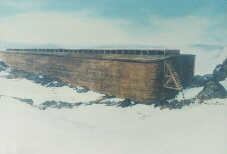
1953 George Green
Helicopter pilot Green described the Ark lying generally in a north-south direction, situated seemingly on a large rock bench or shelf on the side of a vertical rock cliff at the 13,000 to 14,000 ft. level. He photographed it, but his photos disappeared in British Guiana when he was murdered there in 1962 (pp. 135-137)