



Evidence Supporting a Recent Creation




 Insufficient
number of supernovas. A new supernova is observed about every
30 years, and we see only a few thousand in existence. --Davies,
K. 1994. Distribution of Supernova Remnants in the Galaxy. Proceedings
of the Third International Conference on Creationism.
Insufficient
number of supernovas. A new supernova is observed about every
30 years, and we see only a few thousand in existence. --Davies,
K. 1994. Distribution of Supernova Remnants in the Galaxy. Proceedings
of the Third International Conference on Creationism.
- Distribution of Supernova Remnants in the Galaxy by Keith Davies
- Exploding stars point to a young universe (Supernova remnants) by Jonathan Sarfati Creation 19(3):46–48 1997
Absence of field galaxies. With stellar evolution, it would seem that some galaxies would not be gravitationally bound and would just spread out in a "field"
--Ackerman, P.D. 1986. It's A Young World After All. Baker Books. pp. 68-70.
Transformation of Sirius B from a red giant star to a white dwarf star within recorded history. This is supposed to take a long time.
--Ackerman, P.D. 1986. It's A Young World After All. Baker Books. pp. 67.
Gravitationally bound star clusters with stars of different ages. If a star cluster is gravitationally bound, under stellar evolution theory one would expect all the stars would be the same age.
--Slusher, H. S. 1980. Age of the Cosmos. Institute for Creation Research. pp. 7-14.
Spiral Galaxies. Keplerian motion should destroy the arms of a spiral galaxy in one to a few rotations of the galaxy - 200-1000 million years at most. However, a huge number of spiral galaxies still exist.
--Slusher, H. S. 1980. Age of the Cosmos. Institute for Creation Research. pp. 15-16.
Star Clusters. Clusters of stars are common, even though they should rapidly break up due to shearing and tidal affects as they rotate around a galaxy's nucleus.
--Slusher, H. S. 1980. Age of the Cosmos. Institute for Creation Research. pp. 16.
Moon Dust and Debris - If the Moon were billions of years old, it should have accumulated a thick layer of dust and debris from meteoritic bombardment. Scientists were concerned that astronauts would sink into a sea of dust, but instead very little meteoritic debris was found. In fact, it was estimated that hundreds of feet and even a mile of thickness would be present, however, after examining rocks and dust brought back from the Moon, scientists learned that only about 1/67th of the dust and debris has even come from outer space.
- Moon Dust - 17 Evidences Against Evolution
- Moon Dust and Debris by Dr. Walt Brown
- How much dust and meteorite debris should the moon have if it is 4.6 billions years old? by Dr. Walt Brown.
- Moon Dust and the Age of the Solar System Dr. Andrew A. Snelling and David E. Rush Creation Ex Nihilo Technical Journal 7(1):2-42, 1993
Existence of short-period comets - The origin of the comets in our solar system is a great mystery from an old universe perspective as they degrade rapidly. While evolutionary astronomers once thought the Oort cloud could account for all comets, the Kuiper belt has been revived to explain their existence.
- Comets and the Age of the Solar System Danny Faulkner. Creation Ex Nihilo Technical Journal 11(3):264–273, 1997
- More problems for the ‘Oort comet cloud’ by Danny Faulkner, Ph.D. TJ 15(2):11, 2001
- The Short Period Comet Problem (for evolutionists): Have Recent Kuiper Belt discoveries solved the evolutionary long age dilemma? by Robert Newton TJ 16(2), 2002.
Existence of unstable rings around planets like Saturn. Rings are not stable and will not last. --Slusher, H. S. 1980. Age of the Cosmos. Institute for Creation Research. pp. 65-72.
- How old are Saturn’s rings-by David M. Harris Creation 12(4):40–41 1990
- Saturn’s Rings — Short-Lived and Young Andrew A Snelling CEN Technical Journal 11(1):1, 1997
- The Delicate Rings of Saturn - The Age of the Universe
Planetary Magnetic Fields - Presence of magnetic fields around solar system bodies (Mercury, Jupiter's moon Ganymede, Neptune, Uranus) without an obvious internal dynamo. No natural process is known which could sustain a magnetic field around these bodies - their magnetic fields should have decayed out of existence if they ever had any.
- Beyond Nepture: Voyager II Supports Creation by Russell Humphreys. ICR Impact 203 May 1990
- The Creation of Planetary Magnetic Fields CRSQ Vol 21 Number 3 Dec 1984 by Russell Humphreys
Recession of the moon from the earth. The moon is moving away from the earth gradually due to tidal activity. This movement is too fast for the earth-moon system to be 4.6 billion years old. --Huse, S. M. 1993. The Collapse of Evolution. Baker Books. pp. 41-42.
-
Young
Age for the Moon and Earth by Dr. Thomas G. Barnes. ICR Impact No. 110 August 1982
by Dr. Thomas G. Barnes - The Moon is Still Young by Malcolm Bowden
- Moon Recession by Walt Brown
Shrinking sun - Sun may be shrinking a few feet each year. Can't extrapolate this trend back to the past very far without effecting earth's environment. --Hinderliter, H. 1989. The Shrinking Sun. Design and Origins in Astronomy. Creation Research Society. pp. 107-112.
- The Sun is Shrinking by Dr. Russell Akridge ICR Impact No. 82 April 1980
- The Young Faint Sun paradox and the age of the solar system by Danny Faulkner, Ph.D. TJ 15(2):3–4, 2001
Absence/shortage of solar neutrinos. Nuclear fusion in the sun's core should give off neutrinos. Experiments have not detected an adequate number of neutrinos - this is a well known problem. Some creationists have argued that this implies solar heat is due to gravity and not fusion - this would imply a young sun.
--Hinderliter, H. 1989. The Shrinking Sun. Design and Origins in Astronomy. Creation Research Society. pp. 113-125.
Continued presence of small meteorites in the face of the Poynting/Robertson effect. Poynting-Robertson effect should sweep the solar system clean of small particles.
--Slusher, H. S. 1980. Age of the Cosmos. Institute for Creation Research. pp. 55-64.
Extensive tectonic activity on Jupiter's moon Io. Inadequate heat sources for a small moon so far from the sun to still be geologically active.
--Ackerman, P.D. 1986. It's A Young World After All. Baker Books. pp. 41-45.
Rock flow and lunar craters - Rock flow should have eliminated old craters on the moon.
--Ackerman, P.D. 1986. It's A Young World After All. Baker Books. pp. 49-53.
Heat level of the sun's corona. Not sustainable for a long time period.
High concentration of Uranium-236 on the moon. Should have decayed.
High concentration of Thorium-230 on the moon. Should have decayed.
Tumbling of asteroid Gaspra. Should have stabilized.
 Nuclear
Decay: Recent experiments commissioned by the RATE project indicate
that "1.5 billion years" worth of nuclear decay took
place in one or more short episodes between 4,000 and 14,000
years ago.
Nuclear
Decay: Recent experiments commissioned by the RATE project indicate
that "1.5 billion years" worth of nuclear decay took
place in one or more short episodes between 4,000 and 14,000
years ago.
- Nuclear Decay: Evidence for a Young World by Russell Humphreys, PhD. ICR Impact 352: Acts & Facts Vol. 31 No. 10 October 2002 Online Issue No. 26
Earth's Magnetic Field: Exponential decay in the earth's magnetic field (half-life of 1400-2000 years). This half-life can't be extrapolated back more than about 10,000 years without the field becoming intolerably powerful.
- Earth's Magnetic Field - Audio lecture by Russell Humphreys
- Earth's Magnetic Age: The Achilles Heel of Evolution by Thomas G. Barnes. ICR Impact No. 122 1983
- Is the Earth's Magnetic Field Evidence for a Young Earth ICR Impact No. 242 August 1993 by Russell Humphreys, Ph.D.
- The Creation of Planetary Magnetic Fields D. Russell Humphreys CRSQ Volume 21, Number 3 (December 1984)
- The Earth's Magnetic Field NASA APOD 2002 November 25 2002
- The Earth’s Magnetic Field is Still Losing Energy by D. Russell Humphreys CRSQ Vol 39 No 1 pp 1-11 June 2002
-
The
Mystery of the Earth's Magnetic Field
- ICR Impact No. 188 February 1989
by Russell Humphreys, Ph.D.
Polonium Halos: Robert Gentry's work showed that the Earth's granite was never in a molten condition, because polonium halos survive only in solid rock and the half-life of polonium is much too short to survive a multimillion-year cooling time. His results seem to indicate that the Earth was created instantaneously, in a cool condition. If true, it is clear evidence for creation and a young earth.
- Creation's Tiny Mystery online book by Dr. Robert V. Gentry
- Evidence for Earth's Instant Creation - Polonium Halos in Granite and Coal - Earth Science Associates
- Creation's Tiny Mystery Explored, by Robert Goette, Ph.D.
- Investigating Polonium Radiohalo Occurrences by John Morris, Ph.D.
- Polonium Halos: Comments on Geological Objections, by Robert Gentry, Ph.D.
- Polonium Radiohalos Still A Very Tiny Mystery by Andrew A. Snelling, Ph.D. ICR Impact No. 326
- Polonium Pleochroic Halos, by Jon Covey
- What significance do radio halos hold for recent creation by Christian Answers Net
Helium diffusion: There is insufficient mass of helium in earth's atmosphere to account for 4.6 billion years of radioactive decay. Helium is a by-product of radioactive decay of some elements. It is a noble gas which doesn't combine with any other element, but there is not enough of it to account for the radioactive decay which should have occurred in an old-earth scenario.
In addition, uranium and thorium in zircons produce helium as a by-product of their radioactive decay. This helium seeps out of (sic) zircons quickly over a wide range of temperatures. If the zircons really are about 1.5 billion years old (the age which conventional dating gives assuming a constant decay rate), almost all of the helium should have dissipated from the zircons long ago. But there is a significant amount of helium still inside the zircons, showing their ages to be 6000 +/- 2000 years. Accelerated decay must have produced a billion years worth of helium in that short amount of time.
- Helium Escape Problem ICR Impact No. 143 May 1985 by Larry Vardiman, Ph.D.
- Helium diffusion rates support accelerated nuclear decay by Russell Humphreys, Steven Austin, John Baumgardner, and Andrew Snelling. 2003. International Conference on Creationism.
- Helium Diffusion Experiments Give Nuclear Evidence for a Young World Powerpoint presentation by Russell Humphreys
- Helium diffusion age of 6,000 years supports accelerated nuclear decay by Russell Humphreys, Steven Austin, John Baumgardner, and Andrew Snelling. 2004. Creation Research Society Quarterly 41(1): 1-16.
- RATE Group Confirms Fast Diffusion of Helium in Rocks by Larry Vardiman
Human population growth: If humans had been around more than a few thousand years, they would have populated the earth more quickly. --Morris, J. D. 1994. The Young Earth. Master Books. pp. 70-71.
-
Evolution
and the Population Problem ICR Impact No. 21 March 1975
by Henry M. Morris, Ph.D.* - Where are all the people by Don Batten Creation Ex Nihilo 23(3):52–55 June–August 2001
Rapid Oil Formation: It has been claimed that oil was formed over 100 millions of years from organic remains, but recent experiments have shown that oil can be produced under the right conditions in a matter of minutes.
“Experiments by the U.S. Bureau of mines showed that petroleum (oil) can be produced from organic material in only 20 minutes.” Hayden R. Appell, Y.C. Fu, Sam Friedman, et al, “Converting Organic Wastes to Oil,” RL-7560 (Washington, D.C., United States Department of the Interior, Bureau of Mines, 1971.)
" British scientists claimed to have invented a way to turn household garbage into oil suitable for home heating or power plant use. 'We are doing in 10 minutes what it has taken nature 150 million years to do', said Noel McAuliffe of Manchester University..." Sentinel Star, 2/26/1982
Middleton, Holyland, Loewenthal, Bruner, "Bottom line - Economic accumulations of oil and gas can be generated in thousands of years in sedimentary basins that have experienced hot fluid flow for similar durations." The Petroleum Exploration Society of Australia No. 24, 1996, p. 6-12
Rapid Wood Petrification: Petrified wood was believed to required thousands or even millions of years, but a US patent now exists that is able to produce petrified wood rapidly.
“A mineralized sodium silicate solution for the application to wood has a composition causing it to penetrate the wood and jell within the wood so as to give the wood the non-burning characteristics of petrified wood.” US Patent & Trademark Office, Patent No. 4,612,050
Argument from tree rings: Tree rings, including rings on petrified forest trees, can't be traced back more than some thousands of years. --Morris, H. M. 1961. The Genesis Flood. pp. 392-393.
-
Redwoods
and the Flood ICR Impact No. 134
August 1984
by Dorothy E. Kreiss Robbins
Absence of large number of human tombs. Humans bury their dead, even in "stone-age" societies, but large numbers of tombs are not found.
Argument from only recent known civilizations. Earliest known civilizations are only a few thousand years old.--Morris, J. D. 1994. The Young Earth. Master Books. pp. 70.
Dating of Niagara falls. Erosion of the system indicates it is only a few thousand years old.--Morris, J. D. 1994. The Young Earth. Master Books. pp. 48-49.
Dating of Mississippi river delta. Erosion rate and amount of sediment accumulated indicate that it is only a few thousand years old. --Mehlert, A. W. "Another Look at the Agea and History of the Mississippi River." pp. 121-123. Creation Research Society Quarterly, December 1988.
Lack of equilibrium of Carbon-14/Carbon-12 ratio. This ratio should reach equilibrium in the atmosphere in only some thousands of years, but it hasn't reached that point yet. --Morris, J. D. 1994. The Young Earth. Master Books. pp. 73-74.
Erosion rate of the continents. Continental mass divided by erosion rate would wash all the continents into the ocean in about 14 million years. --Morris, J. D. 1994. The Young Earth. Master Books. pp. 88-90.
Sediments in the Ocean. Present erosion rate could produce all the existing ocean sediment in only 15 million years. --Morris, J. D. 1994. The Young Earth. Master Books. pp. 90.
Amount of salts in the ocean divided by rate of influx. This is actually many dating methods - one for each salt which can be measured. For example, all the sodium chloride in the ocean would have been washed in in about 62 million years, if the ocean was pure water to begin with. --Morris, J. D. 1994. The Young Earth. Master Books. pp. 85-87.
Amount of water on earth's surface / rate at which it is expelled from below ground. Enough water is expelled from deep below the earth via volcanoes, etc. to rapidly produce more than all the water on the earth's surface. --Morris, H. M. 1961. The Genesis Flood. Presbyterian and Reformed Publishing Company. pp. 387-389.
Pressure in oil reservoirs. Couldn't have stayed high for millions of years.
--Huse, S. M. 1993. The Collapse of Evolution. Baker Books. pp. 40-41.
Rate of accretion of the earth's crust due to volcanism. Volcanic activity could produce the entire earth's crust in only 1.2 billion years even with no crust to begin with.
--Morris, J. D. 1994. The Young Earth. Master Books. pp. 88.
Uranium Halos
--Morris, J. D. 1994. The Young Earth. Master Books. pp. 62-64.
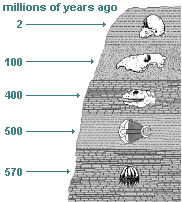
The geologic column (representing all the earth's observed sedimentary rock) in classical geology represents hundreds of millions of years of evolutionary history. Evidence that this column formed rapidly rather than over millions of years is therefore evidence for a young geologic column and a young earth.
Absence of meteorites in the geologic column.
"Counting the number of asteroids we see in the sky suggests that over the past 250 million years, Earth should have been hit around 440 times by asteroids larger than one kilometre across. But scientists have found only 38 large impact craters from this period." New Scientist December 02
- Earth's volcanism linked to meteorite impacts New Scientist December 02
--Ackerman, P.D. 1986. It's A Young World After All. Baker Books. pp. 25-28.
Polystrate fossils - are fossils which cross multiple geologic layers which were supposedly laid down millions of years apart. Trees trunks are frequently found to cross several layers and even through coal beds showing that these layers formed rapidly. Some polystrate trees are even found upside down providing obvious testiment to catastrophic upheaval.
- Pillars, Polystrate formations, and Potholes by Douglas E. Cox
- Polystrate Fossils and the Creation-Evolution Controversy
- Polystrate Trees
- Polystrate Trees
-
Polystrate
Trees and Coal Seams of Joggins Fossil Cliffs ICR Impact No. 316 October 1999
by John D. Morris, Ph.D.* - The Yellowstone Petrified Forests by Jonathan Sarfati Creation Ex Nihilo 21(2):18–21, March–May 1999
- Petrified Forests of Yellowstone ICR Impact No. 268 October 1995 by John D. Morris, Ph. D.*
- What Are Polystrate Fossils BTG No. 81b September 1995 by John D. Morris, Ph.D.*
Rapid Coal Formation - It has been claimed that coal takes millions of years to form, however, in recent laboratory experiments by Dr. George R. Hill and Dr. Don C. Adams at the University of Utah it has been shown that plant matter can be turned into coal in a matter of hours.
GEORGE R. HILL Dean of College of Mines
& Mineral Industries, "A rather startling and serendipitous
discovery resulted....These observations suggest that in their
formation, high rank coals,....were probably subjected to high
temperature at some stage in their history. A possible mechanism
for formation of these high rank coals could have been a short
time, rapid heating event." [Six Hours], Chemtech, May,
1972, p. 292-296.
- Coal Evidence for a Young Earth
- Mt.St.Helens Key to rapid coal formation by John Mackay, B.Sc. Creation Ex Nihilo 6(1):6–8
- Polystrate Trees in Coal Beds
- Rapid formation of coal Proof that strata form rapidly and that the earth is young.
- The Origin of Coal ICR Impact No. 41 November 1976 by Stuart E. Nevins, M.S.
Turbidites are evidence of rapid strata formation. These sedimentary rocks result from sediments of turbidity currents and are believed to comprise as much as 50% of the geological column, and approximately 30 of the deposits visible in the Grand Canyon.
Ripple marks, rain drops, and animal tracks in sedimentary rocks. This implies very rapid burial and hardening because these fragile features could not survive even trivial erosion. --Morris, J. D. 1994. The Young Earth. Master Books. pp. 94-96.
Regional deposition. Current known geologic processes don't account for regional deposits (covering multiple U.S. states, for example). This applies to types of rocks, as well as coal and oil reserves.
Deformation of strata implies it was soft when deformed and hadn't hardened into rock. --Morris, J. D. 1994. The Young Earth. Master Books. pp. 106-109.
Absence of bioturbation in the geologic column. Biological activity soon disturbs sedimentary deposits formed by modern catastrophes (hurricanes, floods) but is not evidenced in the geologic column. This implies that the geologic column was buried very deeply very rapidly. --Morris, J. D. 1994. The Young Earth. Master Books. pp. 96-97.
Lack of recognizable soil layers in the geologic column. Soil material is seldom found in the geologic column. One would think that the earth had soil layers in the past, and if it was slowly buried, some would be preserved. --Morris, J. D. 1994. The Young Earth. Master Books. pp. 97-98.
Undisturbed bedding planes. Different geologic rock layers often show sharp, knife-edge breaks between layers, with no evidence of erosion between. This is not realistic if the layers formed over long periods of time.
--Morris, J. D. 1994. The Young Earth. Master Books. pp. 98-100.
Clastic dikes: Clastic dikes are formed from soft sand squeezed up through newer layers of rock. This implies that the sandy older (lower) layer was still soft enough to squeeze sand up (like squeezing a toothpaste tube) through the younger upper layers. --Morris, J. D. 1994. The Young Earth. Master Books. pp. 109-112.
Limited Extent of Unconformities. Much of the geologic column is continuous in its deposition, with no evidence of erosion between layers. This indicates that the process took only a very short time. --Morris, J. D. 1994. The Young Earth. Master Books. pp. 103-105.

Age of the Earth and Cosmos: Creation Books and Videos
|