


Gene Hijacking:
The Role of Interspecies Gene Transfer
Introduction
Through the application of biotechnology, it has become apparent that interspecies gene transfer between unrelated organisms may be occurring naturally. Researchers have thoroughly demonstrated that prokaryotic and eukaryotic cells will uptake and incorporate foreign DNA from any other organism. If the genetic material is inserted adjacent to the necessary upstream regulatory sequences, then expression of foreign genes will also occur. As this process is performed by the host cell, and can not occur otherwise, it therefore exists by design, and presumably for the purpose of allowing organisms to steal genes or nucleotide sequences from others. The ramifications expressed as evolutionary potential are enormous.
Genetic Transformations
Biotechnologists have developed gene transfer techniques over the past couple of decades by trial and error. Although the co-cultivation of cells with DNA is all that is required, most techniques expose tissues to stresses which would breech the plasma membrane, and or cell wall in the case of plants. Following this exposure; some of the cells will possess the foreign DNA in their genome.
Biolistics is probably the most commonly used technique to genetically transfects cells.(Figure 1) The apparatus used is also affectionately called the Gene Gun because it uses a high pressure delivery system to blast gene-coated metal particles into plant or animal tissue. Other procedures utilize electrical pulses, sonication, or agitation with glass beads or fibers. All of these techniques are simply used to improve the transformation efficiency by increasing the frequency of contact between the foreign DNA and the would-be host cell.
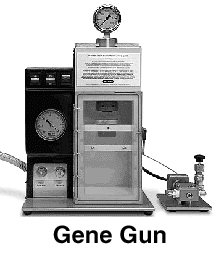
Fig. 1. Gene Gun. Biolistics or the "gene gun" is the most commonly used technique for performing genetic transformations. It employs a high-pressure delivery system to shoot tissue with gold or tungsten particles that are coated with DNA. Although the gun's propulsion is now most typically accomplished using a pressurized gas such as helium, the original version of this system from Bio-Rad was equipped with a 22-caliber pistol and blank cartridges. After being peppered with foreign DNA, some of the cells will transport the sequences into the nucleus and splice them into the genome.
It is however, the recipient cell which accepts the foreign DNA, protects it from degradation, transports it through the nuclear membrane, and splices it into an unwound section of chromosomal DNA where it becomes a permanent and heritable addition to the genome. Given the nature of the techniques used, it may also then be apparent that any abrasive exposure between two organisms could provide the necessary contact for gene transfers to occur.
Design and Genetics of Evolution
God is the ultimate genetic engineer, and within our cells exists a molecular-machinery far beyond our comprehension. Evolution occurs by design through a history of genetic recombination and natural selection. The genetic variability that produced Darwin's finches was not introduced randomly during replication errors, but instead specifically created by cellular machinery. This has been thoroughly established by Mendelian genetics, and the breeding histories of countless domesticated animals, however whenever an evolutionist refers to the source of genetic variability responsible for natural varieties it is always attributed to mutations.
The variations found among offspring from the same parents are produced by recombination events performed during gametogenesis, not random mutations, and it is from these differences that nature selects and through which evolution occurs. We do not yet understand exactly how these reactions are performed, nor can we yet even determine how many subsequently occurred during meiosis. All we know is that they indeed occur, and their purpose is obviously to provide evolutionary potential, and allow the creatures on earth to successfully occupy a variety of habitats.
It is pure naturalistic assumption that mutations are creating new alleles. Following division, there is however no way to determine if the changes in the genome were the result of mutation or recombination, but there is great reason to expect it to be the latter. The genome is manipulated in two profound ways; one is the replication of the genome, and the other is genetic recombination. It is well known that replication is performed under rigid control, and the cell possesses mechanisms to correct errors when they occur. We also know that recombination intentionally changes the genome of each gamete so no two cells are ever genetically identical. It is well known fact that meiotic recombination is responsible for the differences between sibling genomic DNA. It is likewise well recognized that these same reactions have alone created the variations of domestic breeds of dogs in only a few hundred years, and yet the evolutionists continually claims mutations are responsible for variations such as the finches on the Galapagos.
Genetic recombination is being performed by God's code editing machinery, and although these reactions are almost totally uncharacterized, a limited ability is assumed by both evolutionists and creationists alike. It is simply assumed that recombination is only rearranging preexisting genes, and replication errors are instead responsible for new genetic code. The truth is however; recombination is intentionally modifying genes to create the biochemical and phenotypic variability from which nature selects. Likewise we can not rule-out the ability of the cell to assemble new reading-frames or use foreign DNA during genomic manipulations designed to promote evolution. Given our present understanding, cellular genetic recombination remain theoretically limitless, and is clearly responsible for variations such as the finches just as they were the domestic breeds.
Natural Interspecies Gene Transfer
The genome possessed by any individual is essentially unique in all the world due to recombination, and any specific lineage may be viewed as a sequence of reactions that could never be reproduced verbatim. Likewise the adaptation to a new or altered environment requires several generation. It may therefore, serve us greatly to have a system that allows an individual to acquire genetic material from others rather than hoping they would be received from their parents.
Contrary to the opinions typical of creation scientists, the genome is not static, nor are organisms limited to the genes they were created with in the beginning. Bacteria are widely known to incorporate foreign DNA. Unfavorable conditions are known to induce genetic recombination, and environmental stresses such as nutrient deprivation will cause bacteria such as Bacillus subtilis to take up exogenous DNA. If there is homology between the foreign and their own chromosomal DNA, the bacteria will integrate almost all of it into there genome through homologous recombination where it can become a permanent part for all future generations. (1)
New genes or alleles are also being assembled during meiotic crossing-overs, and passed to the next generation. God may also have provided each organism with the ability to take advantage of the genetic material possessed by others. The potential benefits are numerous, but the most obvious may be the rapid acquisition of genes or polynucleotide compounds.
Following a lengthy history of struggle in a particular region, organisms assemble useful sequences or gene combinations. With each generation, the best-fitted offspring selectively passes its combination of genes to the next. The well adapted organism likely possesses specific required polynucleotide strings that it might have spent generations perfecting under selective pressure. Such regionally-specific genes can instead be acquired through interspecies gene transfer, and the newcomer may instead be able to essentially hi-jack genes from an unrelated species after even chance contact.
Agrobacterium; Gene Thief and Biotech Engineer
Agrobacterium Tumerfaciens is a bacteria commonly used by biotechnology engineers around the world to genetically transform plants. In nature, this microbe is responsible for inducing a tumor-based pathogenesis known as Crown-Gall disease pictured at right. The cancerous growth is caused through the genetic transformation of the plant by the microbe. Agrobacterium is not only a naturally occurring interspecies genetic transformer, but some of the sequences it is inserting were stolen previously from a plant at some point in its history. The Agrobacteria is an excellent example of interspecies gene transfer and genetic construction in action.
Through the transfer of a portion of plasmid DNA called the T-DNA, the Agrobacterium forces the plant cells to make an amino acid (opines) that only the bacteria can metabolize as a fuel source. The single cell organism essentially parasitizes the plant by inserting foreign DNA that the plant translates into unusable protein. In addition to the genes that code for opines, the Agrobacterium also inserts other genes to cause a tumor or uncontrolled replication of transformed cells.
Perhaps the most interesting aspect of this natural interspecies gene transfer is the fact that the genes the bacteria is inserting are under the control of plant regulators, and the tumor inducing genes are not of a bacterial origin, but plant growth regulators. The Agrobacterium is using genes to perform this parasitism that it was likely not created with, but instead their very specific use suggests that bacteria generally have the ability to assemble DNA constructs through genetic recombination, and frequently use foreign sequences during such procedures.
New Genetic Information
Although genetic recombination using native sequences is probably the primary source of new alleles, we can not rule out the possible acceptance and use of foreign DNA during this process. Interspecies gene transfer is easily accomplished in laboratory settings, and evidence from living populations is also substantiating that horizontal movement of DNA is occurring naturally and with some regularity.
The ability of cells to uptake and utilize foreign DNA, and likewise the mechanisms to construct new genetic information remains unrecognized by the majority of the creation science community. The secular scientific community is similarly adamant that all new genes are the result of mutations, and refuse to acknowledge the intentional role of genetic recombination in the evolution or organisms.
The typical creationary view of evolution is tainted by secular teachings concerning mutations. Likewise the creationist has an overwhelming desire to argue evolution which leads to a refusal to accept that new alleles are being created through time. However, the molecular machinery creating this new genetic information is still almost completely beyond our comprehension, and has been designed by an intelligence that will not allow us to presuppose limits upon these mechanisms. The sources of new genes remains theoretical but clearly exist by design, and may include the use of foreign DNA. Although these matters may not be thoroughly elucidated within our lifetimes, until such time they must remain theoretically limitless given who designed the blueprints.
Article References
1) Homologous genetic recombination as an intrinsic dynamic property of a DNA structure induced by RecA/Rad51-family proteins: a possible advantage of DNA over RNA as genomic material. Proc. Natl. Acad. Sci. U.S.A. 98, 8425-8432 (2001) Shibata, T., Nishinaka, T., Mikawa, T., Aihara, H., Kurumizaka, H., Yokoyama, S. & Ito, Y.
3 Genome fragment of Wolbachia endosymbiont transferred to X chromosome of host insect. Natsuko Kondo, Naruo Nikoh, Nobuyuki Ijichi, Masakazu Shimada, and Takema Fukatsu. Proc. Natl. Acad. Sci. U.S.A. 99(22):14280-14285 (2002)
This Section was Edited-out of "Genetic Variability by Design"
The development of genetic transformation technology has illustrated yet another function of HR. Through the application of biotechnology, it has become clear that the typical genome is relatively flexible in size, and will incorporate almost any extracellular DNA if there is sufficient homology. For example, prokaryotes readily uptake foreign nucleotides during times of stress, and all major taxa are able to exchange genes across species barriers using HR. In fact, it was the genetic transformation of bacteria in the late 1920's that finally led to the discovery of DNA as responsible for the heredity of traits. All cell types can now be genetically transformed in the lab with little difficulty, and biotechnologists routinely use this ability to create genetically modified organisms, such as herbicide or insect resistant crops. Many of the procedures used to transfect plant and animal tissues with DNA will simply stress the cells or breech the plasma membrane in the presence of the desired genes.(Figure 3) Following these exposures, the cellular machinery is exclusively responsible for transporting the DNA into the nucleus and splicing it into the genome. Natural genetic transformations across species barriers have also between reported. The adzuki bean beetle was found to have incorporated genes from the endosymbiotic bacteria Wolbachia., and there is also the well-known example of Agrobacteria, which genetically transforms wounded plants creating a tumor called Crown Gall disease.
News of Horizontal Gene Transfer
- Genes caught skipping from bacteria to beetle Tokyo team claims first direct evidence of horizontal gene transfer. 9/27/2002
- Chagas parasite invades genome Typanosomacruzi kinetoplast DNA found in the genomes of infected patients and animals. The Scientist 7/23/04
Secular Agrobacterium Refs
- Agrobacterium tumefaciens
- Agrobacterium tumefaciens biology and the control of Crown Gall
- Pathogenesis of Agrobacterium Animation and Graphics
- T-DNA
- The Agrobacterium tumefaciens gene transfer to plant cell. Review article
- University of Washington Crown Gall Group

|
$8.95
|
$17.99
|
$62.95
|
$12.59
|
|
$14.39
|
$11.70
|
$11.70
|
$11.70
|
|
$16.15
|
$18.95
|
$11.69
|
$17.95
|
|
Regular price: $107.70
Sale price: $80.76
|
$16.15
|
$15.29
|
$14.39
|
|
$12.59
|
$12.59
|
$11.70
|
$17.95
|
|
$11.70
|
$11.70
|
$22.49
|
$16.95
|
|
$11.70
|
$16.15
|
$11.70
|
$16.15
|
|
$22.49
|
$8.99
|
$12.59
|
$11.70
|
|
$17.95
|
$17.95
|
$17.95
|
$11.69
|
|
$20.65
|
$20.65
|
$16.15
|
$14.39
|
|
$9.95
|
Regular price: $38.94
Sale price: $31.18
|
$11.69
|
$11.69
|
|
$11.69
|
$17.95
|
$8.95
|
$8.95
|
|
$11.70
|
$11.70
|
$12.79
|
$22.49
|
|
$25.95
|
$18.95
|
$18.95
|
$21.95
|
|
$17.95
|
$13.45
|
$16.15
|
$8.95
|
|
$8.95
|
$22.49
|
$22.49
|
$22.49
|
|
$17.99
|