


What's Driving Evolution:
Mutation or Genetic Recombination?
See Also | Genetic Variability by Design technical review article
Introduction
 There
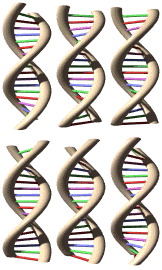
are two possible sources of the genetic variability that must be introduced
into a population for change to take place: mutation and
genetic recombination. Mutations are random nucleotide
alterations such as copying errors or changes induced by external mutagens.
In contrast, genetic recombination is performed by the cell during the
preparation of gametes (sperm, egg, pollen) which are used for sexual
reproduction.
There
are two possible sources of the genetic variability that must be introduced
into a population for change to take place: mutation and
genetic recombination. Mutations are random nucleotide
alterations such as copying errors or changes induced by external mutagens.
In contrast, genetic recombination is performed by the cell during the
preparation of gametes (sperm, egg, pollen) which are used for sexual
reproduction.
The genomic differences between any two siblings are tremendous, and with rare exception all of those genetic distinctions were specifically created recombination. Both recombination and mutations can contribute to the evolution of an organism, but genetic recombination is the primary source of the genetic distinctions between individuals in a population, and must therefore be the principal driving force behind evolution .
Recombination vs. Mutation
 Although
genetic recombination was
discovered following the formation of Darwin's theories of evolution, it is
still claimed that mutations are the source of any natural variability. It
has however, now been known for decades that the variety of characteristics
found among offspring from the same parent, or between the various breeds of
plants and animal are the result of recombination events during meiotic cell
division (crossing over and independent assortment of homologues). Little is
known about homologous crossing over, but reactions between parental
chromosomes occur during the production of gametes (sperm, eggs). These
rearrangements alter the genetic constitution distributed to each daughter
cell so no two are ever identical (i.e. DNA fingerprinting).
Although
genetic recombination was
discovered following the formation of Darwin's theories of evolution, it is
still claimed that mutations are the source of any natural variability. It
has however, now been known for decades that the variety of characteristics
found among offspring from the same parent, or between the various breeds of
plants and animal are the result of recombination events during meiotic cell
division (crossing over and independent assortment of homologues). Little is
known about homologous crossing over, but reactions between parental
chromosomes occur during the production of gametes (sperm, eggs). These
rearrangements alter the genetic constitution distributed to each daughter
cell so no two are ever identical (i.e. DNA fingerprinting).
As a result of genetic recombination, the genomic constitution of each offspring is unique in all the world. In comparison to recombination, the changes induced by mutations are totally insignificant. Mutations are also disruptive to normal gene function, and corrected by the cell when detected. However, random mutations produce biochemical and phenotypic alterations so they can be beneficial on rare occasions. Nevertheless, the genetic changes that the breeders have been isolating are not the result of random mutation, and it is these same type of variations in nature that are attributed to mutation. The variations created during meiosis were performed by the cellular machinery to alter the characteristics common to the organisms and thereby drive the evolution of the organism.
 It
is well recognized that the variations of plant and animal breeds were
created through a history of recombination, selection, and inbreeding which
creates a genetic homozygote. We know the
variations isolated by breeders are the result of recombination and not
mutation due to the short period of time involved with the isolation of the
varieties, and the fact that the features segregate out in the offspring
based on classic Mendelian predictions. In nature this process of
recombination and selection has allowed organisms to specialize to
particular habitats or niches, and is likewise responsible for the natural
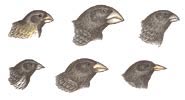
variations such are Darwin's finches which are so often used as examples of
evolution via mutation.
It
is well recognized that the variations of plant and animal breeds were
created through a history of recombination, selection, and inbreeding which
creates a genetic homozygote. We know the
variations isolated by breeders are the result of recombination and not
mutation due to the short period of time involved with the isolation of the
varieties, and the fact that the features segregate out in the offspring
based on classic Mendelian predictions. In nature this process of
recombination and selection has allowed organisms to specialize to
particular habitats or niches, and is likewise responsible for the natural
variations such are Darwin's finches which are so often used as examples of
evolution via mutation.
Source of New Alleles
It is clear the genome is not static, and the cell's molecular machinery is altering the genome with each passing generation. Although it is well recognized that recombination occurs, mutations are still credited for all new alleles. The mitochondrial has been used for years to substantiate that mutations create new alleles because it was previously thought the organelle's genome was obtained exclusively from maternal contributions during fertilization, however it has been recently reported in the journal Science that recombination between parental genomes also occurs in mitochondrial DNA. Evidence of mixing of paternal with maternal DNA in the mitochondria was evident, and it was concluded that there was recombination between the father's and mother's mitochondria. (Science 286:2524-2525)
Despite ready knowledge of recombination, it is taught that all new alleles are the result of mutation. Crossing-over is still almost totally uncharacterized, and we can not yet determine what specific reactions have occurred subsequently, but we do know they are being performed by the cell on genomic and organelle DNA. These reactions are the reason why siblings are unique, how variations are produced during selective breeding, and the source of variability in the population generally. New alleles are more likely the result of genetic recombination, and the purpose of these reactions is clear. They occur to make the genetic manipulations necessary so organisms would be able to adapt physically and biochemically, and thereby occupy earth's broad range of habitats.
Random or Controlled Variability
Genetic recombination is not random. Offspring survival following genetic recombination is just short of 100% among all sexually reproducing organism substantiating these reaction as highly controlled and specific. We can also not predict the ability of these reactions to modify an organism. We have been taught that the sources of population variability are random. The crossing-over reactions are claimed to be randomized exchanges although it is a given juggling genomic DNA would produce extremely high infant mortality rates. Truly, the genetic changes induced during meiosis are a highly controlled and pin-point specific reactions which occur by design to produce populations with variability.
Since we know all the various breeds animals were created through genetic recombination, why are we taught every variation of animal in nature is a result of mutations?
Mutations are a theoretic necessity for atheistic evolution which is attempting to substantiate the origin of life through the mechanisms that are allowing organisms to adapt. For the theory to explain the existence of life, the source of variability driving this process must not be reliant upon a living system. To the atheist, the driving force behind evolution must be a random source. Although the molecular machinery is still largely beyond our comprehension the scientific community can not recognize the design inference its complexity suggests, and will not acknowledge the obvious; that evolution is solely reliant upon the genetic manipulation created by the cell.
Since homologous recombination is performed by the cell, it therefore occurs by design, and we do not understand these reactions well enough to recognize the capability of these genetic modifications. The real power behind genetic recombination has not yet been recognized. Given our knowledge, it may be assumable that these reactions are the exclusive source of new alleles or genetic information, but we should not yet attempt to theoretically limit their ability to manipulate the genome.
