



Channeled Scablands:
Scientific Bias Against Catastrophism
Related Articles
- Only One Lake Missoula Flood by Michael J. Oard
- Evidence of the Flood in Franklin County by Gerald Durr
Prior to the 19th century, most geologists were catastrophists who believed that the earth's fossiliferous rock was the result of the Biblical global flood. Around 1850 a major shift in thinking started to take hold, and the geological discipline began to develop into what it is today. As evolutionary theory began to spread, so did the idea that the earth was very old. Geologists began to interpret features, such as flood plains and canyons, based on current rates of deposition and erosion. Uniform rates and intensities were instead proposed as being the force behind the monumental quantities of flood sediment that covers the world. Uniformitarianism still governs the minds of geologists today.
 Modern geology has been largely founded upon the
need by naturalists to explain our world
independent of supernatural Biblical references such as the global flood.
Even a suggestion that massive floods were involved with the formation of
geologic features can subject a person to scorn and cause them to become
ostracized by their fellow peers. An example of this attitude is illustrated
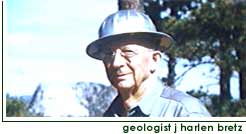
by the story of Harlen Bretz, who proposed in the 1920s that the topography
of eastern Washington State was the result of a massive catastrophic flood.
Modern geology has been largely founded upon the
need by naturalists to explain our world
independent of supernatural Biblical references such as the global flood.
Even a suggestion that massive floods were involved with the formation of
geologic features can subject a person to scorn and cause them to become
ostracized by their fellow peers. An example of this attitude is illustrated
by the story of Harlen Bretz, who proposed in the 1920s that the topography
of eastern Washington State was the result of a massive catastrophic flood.
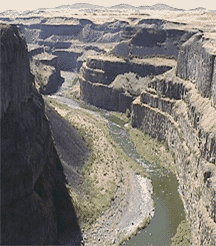
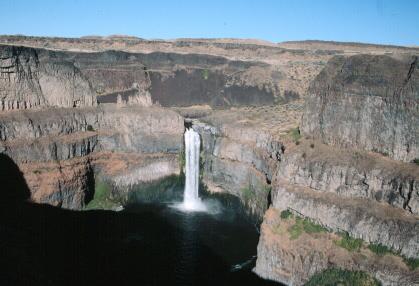
Harlen Bretz's named this area of eastern Washington the Channeled
Scablands. The idea that sites such as the Palouse Falls Gorge pictured at left were
the results of floods was thought to be outrageous, and described by some as
near lunacy since the area receives very little rainfall today.
 It
took many decades for Harlen Bretz to finally receive the credit he
deserved. In fact, it was not until the area was observed from the air that
many of the Scabland features were accepted as flood deposits, such as
the giant ripples pictured at right, which are up to 30 feet high and 250
feet apart.
It
took many decades for Harlen Bretz to finally receive the credit he
deserved. In fact, it was not until the area was observed from the air that
many of the Scabland features were accepted as flood deposits, such as
the giant ripples pictured at right, which are up to 30 feet high and 250
feet apart.
Almost fifty years following
his original proposal, Bretz was hailed as a hero, and in 1979, at the age of 96, he
was given geology's highest honor — the Penrose Medal, which rewards one
researcher each year for exceptional contributions to geology. The Channeled Scablands have
now been dedicated to Harlen Bretz, and it is
commonly known that this area was destroyed by a massive flood catastrophe.
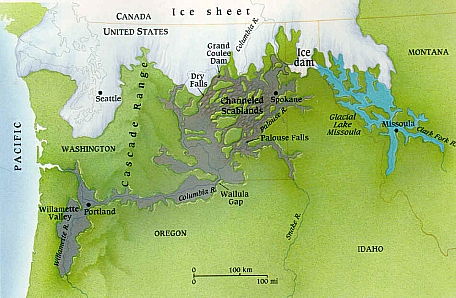
The flood
was caused when a large glacial lake, called lake
Missoula, broke through its natural dam and destroyed the majority of
eastern Washington. During the Missoula flood stratified layers and canyons
were formed rapidly. These features are common to our world and geologists
are quick to interpret them as the result of slow and gradual processes
because they cannot accept that the Biblical global flood was responsible.

"Bretz knew that the very idea of catastrophic flooding would threaten and anger the geological community." Andrew Macrae, University of Calgary, Department of Geology & Geophysics
The geological community is threatened by the idea of catastrophic flooding because the most obvious interpretation of the fossil record is a global flood. Unfortunately geologists cannot correctly interpret the world's geology because today the community is comprised exclusively of naturalists. The Bible says there was a supernaturally-based global flood and animals are only alive due to an act of supernatural intervention. Contrary to this testimony, the deposits that cover the world must be explained by naturalists as though these animals survived the formation of the flood deposits naturally. Although the earth is completely covered in hundreds of feet of flood sediment, they must instead propose that it all accumulated so slowly and gradually that life was able to exist atop that material during its formation. If geologists cannot recognize that the Channeled Scablands were the result of a flood, how can they recognize the Biblical global flood?
"In the end, the ‘truth’ of catastrophism did win, but it took more than 50 years to see the project through. And this was despite the fact that the event in question was relatively easy to document through field observations." E. K. Peters, No Stone Unturned: Reasoning About Rocks and Fossils, 1991, pp. 78 and 84.
The Lake Missoula Flood
Perspectives from Creationist
- Only One Lake Missoula Flood by Michael J. Oard Originally Published by Answers in Genesis TJ, 14(2):14-17, 2000
- Evidence of the Flood in Franklin County by Gerald Durr
- Evidence for Only One Lake Missoula Flood, and Implications for other Genesis Flood and Ice Age Events by Michael Oard - DSA Newsletter 10/01
- Field studies in the Columbia River basalt, north-west USA by John Woodmorappe and Michael Oard. TJ 16(1):103–110 2002
- Geologic Worldviews and the Global Flood PowerPoint lesson by Chris Ashcraft
- The story that won’t be told The planned Lake Missoula flood interpretive pathway by Michael Oard
Secular Resources
-
 Channeled
Scablands by Kids Tour to Mars
Channeled
Scablands by Kids Tour to Mars - Channeled Scablands Theory by Spokane Outdoors
- Columbia Plateau - Channeled Scablands Field Course - Schwert
- Floods: Rising Waters and You - Teachers Resources Grade 9-12 Videos
- Glacial Lake Missoula and the Ice Age Floods Virtual Tour (Pictures)
- Ice Age Floods Institute a non-profit organization committed to tell the story of the cataclysmic floods that swept across the Pacific Northwest thousands of years ago
-
Ice Age Floods Alternatives
Study by the National Park Service
- Section D Geologic Background by the NPS
- Ice Age Trip (Pictures)
-
Kids Cosmos Field Trip
to the
Channeled Scablands1 -
Channeled Scablands2 -
Dry Falls2
- Lake Missoula and Cataclysmic Floods
- Missoula Flood Research
- The Missoula Floods by Oregon Public Broadcasting
- Natural Wonders Rock of ages' roiling tale The Seattle Times Local News 2/10/03
- NOVA Mystery of the Megaflood - Explore the Scablands - PBS
- Planetary Geology Field Trip to the Channeled Scablands 2000 by NASA and the Washington Space Grant Consortium
- The Dry Falls Story by NASA and the Washington Space Grant Consortium
- The Death of the Dinosaurs, Superfloods, and other Megacatastrophes based on a lecture in 1998
- The Geology of the Ice Age Floods and Channeled Scablands of Eastern Washington
Scabland Field Trip Information
Creation Science Tours
- Channeled Scablands Tour 9/2001 by the Design Science Association
- Channeled Scablands Tour 9/2003 by the Design Science Association
Other Tours and Info
- Bus Tour to Mars (Channeled Scablands)
- Dry Falls, Washington, USA. Guide to Dry Falls by Go Northwest
- Eastern Washington Map
- Field Trip to Mars Overview This virtual field trip compares the Channeled Scablands with Mars in attempt to prove that the Martian topography was also formed by flooding. It serves as a step by step guide through important features of the Channeled Scablands.
- Geological Society of America Channeled Scablands Trip, 1994
- Geological Society of America Glacial Lake Missoula Trip, 2003
- National and Washington State Parks
- Roadside Geology of Washington Book
- The Columbia River Connection Tours
- Washington's Outer Limits Dry Falls