



The Geological Column
Indeed, it is the chief frustration of the fossil record that we do not have empirical evidence for sustained trends in the evolution of most complex morphological adaptations."Stephen J. Gould and Niles Eldredge, 'Species Selection: Its Range and Power,' 1988, p. 19
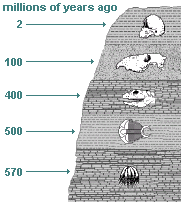 The geological column is a tremendous
blanket of sedimentary rock that has been found to cover the
entire earth. Layers of flood liberated deposits of sandstone,
limestone, and shale completely cover every landmass by hundreds
of feet. This thick strata has been interpreted by secular scientists
to represent the history of life on earth over more than 600
million years. Except where erosion and uplift has removed these
layers, there is not one square inch on earth not covered in
thick flood strata. The geological column can be traced across entire
continents and correlated with similar layers on other continents.
The geological column is a tremendous
blanket of sedimentary rock that has been found to cover the
entire earth. Layers of flood liberated deposits of sandstone,
limestone, and shale completely cover every landmass by hundreds
of feet. This thick strata has been interpreted by secular scientists
to represent the history of life on earth over more than 600
million years. Except where erosion and uplift has removed these
layers, there is not one square inch on earth not covered in
thick flood strata. The geological column can be traced across entire
continents and correlated with similar layers on other continents.
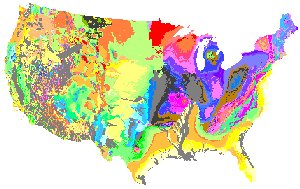
The following map of the united states is a US Geological Survey illustration showing the various layer of the geological column exposed nation-wide. Some layers of strata such as the Mississippian and Pennsylvanian were named due to their discovery within these specific states of the US. It is not uncommon for sedimentary rock to be kilometers thick in places. The depth and quantity of these beds is so extensive that a mechanism for their deposition is almost unimaginable, and it would appear truly miraculous that terrestrial life still exists upon so much flood sediment.
 Simply
put, the geological column has been misinterpreted due to a failure of the
scientific community to recognize the occurrence of the global
flood, and there is
evidence
these formations are relatively young. The flood strata does
not represent a history of millions of years of accumulation,
but is an obvious record of a world-wide devastating catastrophe
that nothing was able to survive naturally.
Simply
put, the geological column has been misinterpreted due to a failure of the
scientific community to recognize the occurrence of the global
flood, and there is
evidence
these formations are relatively young. The flood strata does
not represent a history of millions of years of accumulation,
but is an obvious record of a world-wide devastating catastrophe
that nothing was able to survive naturally.
The fossils found within the geological
column are sorted or frequently only found in a few specific
layers. It is thought this differential positioning illustrates
the history life on earth, and the
evolution
of one type of organism to another. However, the
sorting of fossils
is instead simply the result of varying death rates of animals
during the flood. The flood waters did not reach their maximum
for
150 days
following the start, and organisms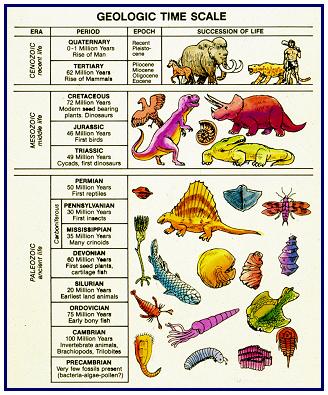 are expected to die at
different times during such a flood due to the possession of
differing habitat elevations, environmental tolerances, migratory
potential and intelligence. With rare exception, all the animals
in the geological column were alive just prior to the flood.
The fossils found deepest within the geological column are simply
immobile and inhabit the lowest elevations possible on earth.
Organisms that are increasingly mobile, tolerant of change, and
intelligent are expected to avoid the rising waters depending
on their abilities and succumb to the catastrophe at different
times.
are expected to die at
different times during such a flood due to the possession of
differing habitat elevations, environmental tolerances, migratory
potential and intelligence. With rare exception, all the animals
in the geological column were alive just prior to the flood.
The fossils found deepest within the geological column are simply
immobile and inhabit the lowest elevations possible on earth.
Organisms that are increasingly mobile, tolerant of change, and
intelligent are expected to avoid the rising waters depending
on their abilities and succumb to the catastrophe at different
times.
Because every animal in the fossil record was alive on earth together, exceptions to their current position are certainly expected, and there are indeed hundreds of documented anomalously occurring fossils. Humans are expected to have been able to recognize the event for its' magnitude and therefore act accordingly in avoiding death to the very end. For that reason, humans are not expected to be found fossilized except on rare occasion, but we can still expect to find human artifacts deep within the geological column. We could also predict examples of living animals like the Coelacanth whose living presence contradicts the fossil record. Evolutionists will need to continue to adjust their position of when organisms evolved because they have misinterpreted the fossil record. With each new discovery they will need to say humans evolved earlier and earlier than previously expected.
Quotes:
"Indeed, it is the chief frustration of the fossil record that we do not have empirical evidence for sustained trends in the evolution of most complex morphological adaptations."Stephen J. Gould and Niles Eldredge, 'Species Selection: Its Range and Power,' 1988, p. 19
"The number of intermediate varieties which have formerly existed on earth must be truly enormous. Why then is not every geological formation and every stratum full of such intermediate links? Geology assuredly does not reveal any such finely graduated organic chain; and this, perhaps, is the most obvious and gravest objection which can be urged against my theory." - Charles Darwin 1902 edition.
"If I, as a geologist, were called upon to explain briefly our modern ideas of the origin of the earth and the development of life on it to a simple, pastoral people, such as the tribes to whom the Book of Genesis was addressed, I could hardly do better than follow rather closely much of the language of the first chapter of Genesis." Wallace Pratt, quoted by W.L. Copithorne, in "The Worlds of Wallace Pratt," The Lamp, Fall 1971, p. 14.
Additional Reading
- Genesis 6-8 - The Flood of Noah
- Evidence of Young Geological Column
- Human Artifacts in the Geological Column
- Geological Column on the CreationWiki